Rīpoata me Atikara
Reports and Journal Articles
Reframing Data as a Taonga: A Māori Data Sovereignty Framework
Journal Article
Simon Lambert, Hauiti Hakopa, Micheal Heimlick
The value of data continues to increase as new technologies have a seemingly insatiable demand for information. This places Indigenous peoples in the difficult position as both users of diverse data for standard and unique ends and the producers of standard and unique data for diverse ends. In Aotearoa New Zealand, Māori have entered scholarly and policy debates on data with typical relish. Yet our communities are at different stages of understanding and empowerment as the owners, producers and users of data. This article details a co-design process in producing a data framework that originated in the biosecurity space but has wider applications. While we use cultural metaphors to explain and communicate our work with the mundane and sacred, we are committed to providing practical templates for groups wanting to engage in research. But just as our data is linked to our people, so are current and future technologies that are subject to influence through societal laws and regulations. We offer some thoughts on how a safer world might arise through working in a more ethical way with Indigenous peoples and their data.

Ihirangaranga: interwoven tapestry of connection through vibration and frequencies
Journal Article
Maree Alicia Hiria Sheehan, Joanne Murray, Valance Smith (Oranga Programme)
This research investigates how the soundscape of Native forests reflects forest health and how it may signal early signs of Kauri Mate (Phytophthora agathidicida; dieback) infection. Grounded in mātauranga Māori (Māori [the Indigenous peoples of New Zealand] knowledge) from Te Rarawa (a tribe in the northern North Island, New Zealand), the study combines Indigenous knowledge with modern technology to develop a sonic-based method for ecological restoration. Recorded soundscapes from healthy kauri (a coniferous tree, northern New Zealand; Agathis australis) are layered with taonga puoro (traditional Māori instruments), karakia (chants), and parāoa (sperm whale) calls, blended with the 528 Hz healing frequency to create immersive environments aligned with the forest’s mauri (life force). This methodology acknowledges the interconnectedness of all living entities and aims to restore ecosystems through vibration and sound. Findings recommend community-led, culturally grounded soundscape interventions to support forest health, while strengthening spiritual and emotional connections between people, place, and environment.
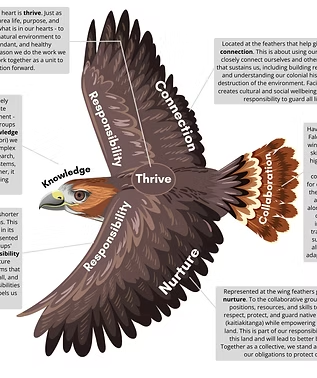
Theory of Change Visuals: Using Diagrams, Metaphors, and Symbols to Communicate Complex Ideas and Get Buy In
Journal Article
Te Tira Whakamātaki, Mariella Marzano, Valance Smith
Everyone can imagine a situation in which they have put in countless hours of work on a new measurement and evaluation framework and, when it is time to get feedback or present their ideas, they have been met with 1,000-yard stares. Conventional approaches can sometimes struggle to engage stakeholders and convey complex concepts. To address this, authors of this article propose a unique, visually based approach that integrates metaphors and symbols into measurement and evaluation frameworks with goals of getting buy-in, portraying complexity, and making evaluation fun for everyone. Termed theory-of-change visualizations, this methodology emphasizes effective communication and facilitation—two key skills authors argue every evaluator should have. The authors advocate for the use of metaphors and symbols that resonate with stakeholders’ experiences and contexts to anchor frameworks in relatable imagery (such as nature-based symbols or culturally significant metaphors). Illustrated through diverse case studies and practical examples, the approach’s usefulness is demonstrated across various contexts, including in both small and large programs with varied outcomes and dynamics. Insights into selecting appropriate metaphors are provided, considering factors such as program characteristics, local context, and audience preferences. Additionally, potential limitations and challenges, including the requisite time, resources, and stakeholder buy-in, are acknowledged and addressed. Integrating visuals portraying metaphors or symbols into frameworks offers a promising avenue for enhancing engagement, understanding, and buy-in for evaluation. By embracing creativity and inclusivity in evaluation practices, this approach can help navigate the complexities of program evaluation for those not in the field while, at the same time, fostering meaningful dialogue and decision-making.

Māori Perspectives on Synthetic Biology for Environmental Protection
Research Report
Te Tira Whakamātaki – August 2024
Te Tira Whakamātaki was included in this project to engage with Māori across Aotearoa on their perspectives of synthetic biology, termed genetic technologies, for environmental protection. TTW’s aim was to examine the cultural, social, and emotional factors that made Māori participants either comfortable or uncomfortable with the use of genetic technology. Our goal is to use this information to spread awareness amongst Māori communities of potential biosecurity tools; inform them of the factors driving attitudes to gene tech; and be a reliable source of information for decision makers to consider when approaching Māori communities with genetic technology proposals.
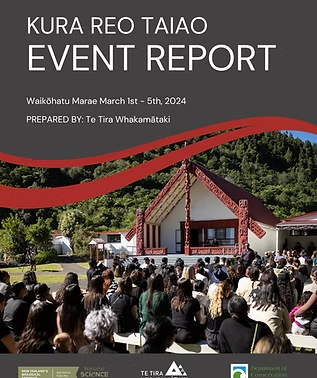
Kura Reo Taiao Evaluation Report
Evaluation Report
Te Tira Whakamātaki – June 2024
From March 1st – 5th 2024, the first Kura Reo Taiao was hosted at Waikōhatu Marae. Sponsored by the Department of Conservation (DOC), the Biological Heritage National Science Challenge and implemented by Te Tira Whakamātaki (TTW), its purpose was to help revitalising environmental and pest management te reo Māori and mātauranga. This report covers the outcomes facilitated by Kura Reo Taiao.

Standing upright here: critical disaster studies viewed from the Antipodes
Journal Article
Steve Matthewman & Simon J. Lambert (Tūhoe, Ngāti Ruapani)
This article seeks to reinvigorate disaster scholarship, given the disastrous times we find ourselves in. In order to do so, we extend the spatial and temporal horizons of disasters, and consider them as normal processes as well as aberrant events. Knowledge need not exclusively emanate from the metropolitan centres of the Global North. We begin by examining the field’s ‘threshold concepts’, subjecting them to an urgent Indigenous evaluation. Second, as cities are the Anthropocene’s primary terrain, we illustrate the numerous ways in which the recovery from the Canterbury Earthquake Sequence offers global lessons. Third, leveraging understandings from the preceding sections, we orient towards a more hopeful intellectual frontier – a decolonised disaster studies as seen from the perspective of Aotearoa New Zealand. Since much disaster scholarship emphasises failure and loss, here we consider what gained through a fuller appreciation of mātauranga Māori.


A Statement on Artificial Intelligence
Statement
Te Tira Whakamātaki – December 2023
At Te Tira Whakamātaki, we recognise the value of new technologies, from AI to GMOs, in planning and operationalising our biosecurity and other environmental activities. Yet we hear from our network and collaborators that so much research is fraught with logistical, ethical, financial and governance demands that always seem to fall on individuals who spend their Tuesday nights in draughty church halls with six other people trying to respond to the latest emergency that has hit their community. Read our statement on Artificial Intelligence here.
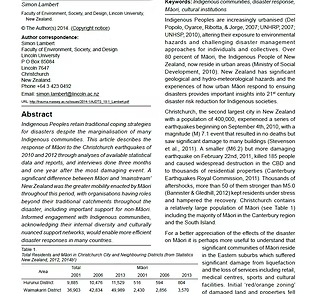
Indigenous Peoples and urban disaster: Māori responses to the 2010-12 Christchurch earthquakes
Journal Article
Simon J. Lambert
Indigenous Peoples retain traditional coping strategies for disasters despite the marginalisation of many Indigenous communities. This article describes the response of Māori to the Christchurch earthquakes of 2010 and 2012 through analyses of available statistical data and reports, and interviews done three months and one year after the most damaging event. A significant difference between Māori and ‘mainstream’ New Zealand was the greater mobility enacted by Māori throughout this period, with organisations having roles beyond their traditional catchments throughout the disaster, including important support for non-Māori. Informed engagement with Indigenous communities, acknowledging their internal diversity and culturally nuanced support networks, would enable more efficient disaster responses in many countries.