Predator Free 2050 & Mātauranga Māori
Research Exemplar
What was the PF2050 Mātauranga Māori Contract?
In late 2022, the Department of Conservation (DOC) released a Request for Proposal seeking a provider to help shape how mātauranga Māori could be explored, developed, and embedded within the Predator Free 2050 (PF2050) programme. Te Tira Whakamātaki applied and was selected to lead this mahi.
Our approach centred on creating space for Māori voices, knowledge, and leadership to thrive within the PF2050 system. The programme was delivered through four interconnected workstreams:
- Te Whare Māta o ngā Kīrearea: A series of Predator Free wānanga grounded in mātauranga Māori, enabling kōrero and exchange among kaitiaki about predator management through Māori ways of being, doing, and knowing.
- Predator Free Kura Reo: A kura reo exploring the depth and richness of te reo Māori as it relates to our environment, with a focus on its role in shaping pest management strategies.
- Māori Data Sovereignty: Research to ensure Māori knowledge, its holders, and their data are protected, appropriately used, and governed within the PF2050 context.
- Predator Free Kāhui: Establishing a governance or advisory group that can design and support the delivery of a PF2050 Mātauranga Māori Contestable Fund, and offer advice and support to the wider PF2050 system.
You can learn more about each of these workstreams, our approaches, and the ways mātauranga Māori benefit the PF2050 system below.
41
PF2050 Resources & Reports
Includes 4 reports, 19 templates, 2 frameworks, 3 Māori led PF2050 resources, and 13 videos – all designed to support and strengthen Māori participation in PF2050.
13
External Media Pieces
Coverage across Waatea News, Te Karere, Aukaha News, Te Ao Māori News, and others – reaching thousands of viewers and amplifying Māori voices in the PF2050 space.
491
Participants
Engaged across events and wānanga delivered through all four workstreams.
14
Key Outcomes Facilitated
Including, among many other impacts, increased understanding of pest control mātauranga, greater awareness of systemic barriers in the PF2050 system, improved ability to apply mātauranga in biodiversity initiatives, and renewed motivation among participants to lead pest control efforts.
Te Whare Māta o Ngā Kīrearea
Predator Free Wānanga for Māori
Providing a Platform for Kaitiaki and Mātauranga Māori in PF2050
At Te Tira Whakamātaki, we believe that the knowledge and solutions needed to achieve Predator Free 2050 already exist. They are held and actively practiced by kaitiaki across Aotearoa New Zealand. Yet many of these knowledge holders and volunteers, are already stretched in capacity, or have been excluded from formal Predator Free spaces and decision-making processes.
While the Predator Free 2050 Strategy recognises that whānau and hapū are natural leaders in pest control, the resources and opportunities have not matched that recognition. This inequity hinders progress toward a truly collaborative and effective national strategy.
To help address this, we designed and delivered the Te Whare Māta o Ngā Kīrearea series. A set of Predator Free wānanga that provided spaces for whānau, hapū, iwi, and experts to come together, share knowledge, build relationships, and explore how mātauranga Māori can contribute to predator eradication. These wānanga were not about teaching Māori what to do, they were about giving space and resourcing to those who are already doing the mahi.
This workstream was grounded in a simple principle, Māori must lead the design, governance, and application of mātauranga and tikanga in pest management. Respect for Māori knowledge systems includes ensuring that these systems are not extracted, misused, or repackaged without consent. Our wānanga demonstrated what leadership, sovereignty, and innovation in this space look like when Māori are empowered to lead.

What We Delivered
In 2023/2024, TTW held four major wānanga.
Te Whare Māta o Ngā Kīrearea
The first was based in Ōtautahi and began with a field trip to Te Rūnanga o Koukourārata in Port Levy, Banks Peninsula. There, we were warmly hosted by Mananui Ramsden, who shared the rich history of the mana whenua and their long-standing environmental programmes. It was an opportunity for participants to connect directly with place-based mātauranga and see how predator control and restoration efforts are being led by hapū on their own terms.
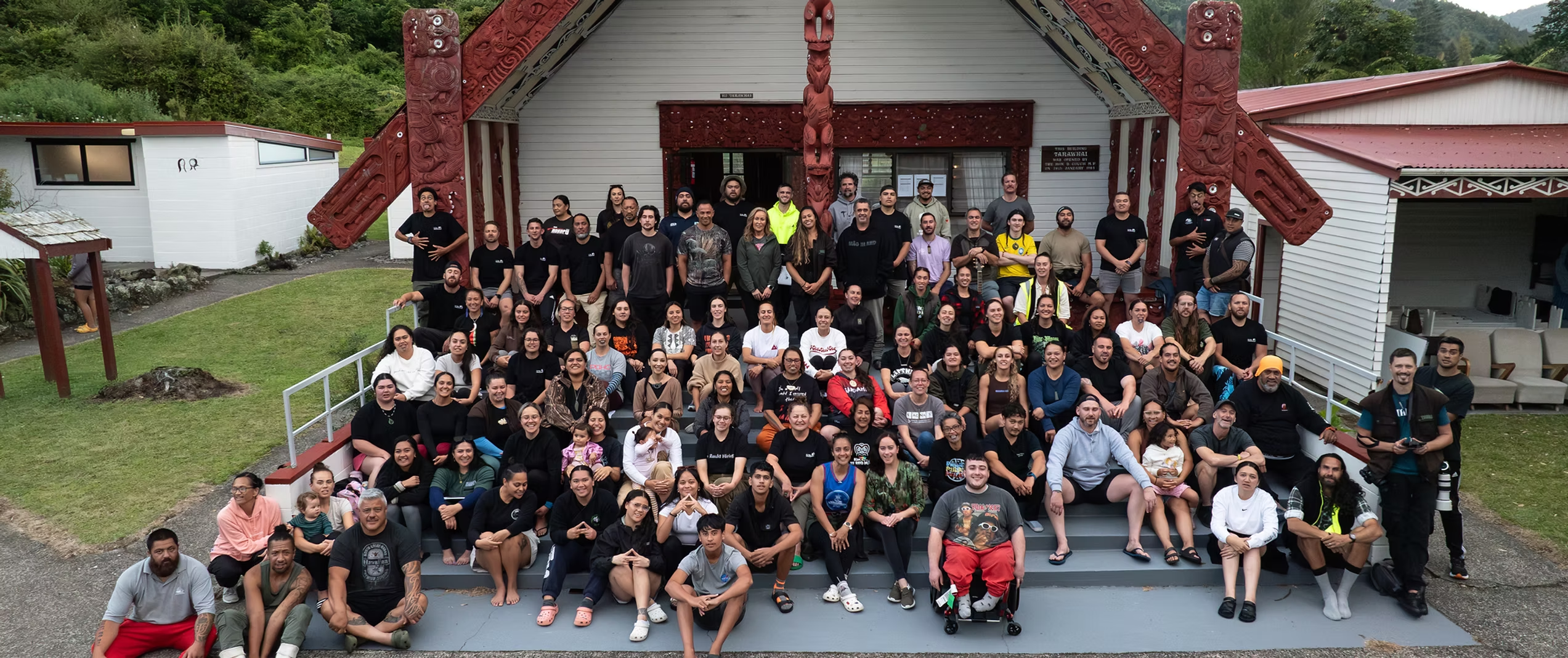
Following the field visit, the wānanga brought together over 150 kaitiaki (with more joining online) to showcase Māori-led predator eradication efforts, introduce whānau to innovative tools and science, and hold important discussions about the contribution of tangata whenua to achieving the Predator Free 2050 vision.
Participants shared what they are doing on their own whenua, engaged with researchers and tool developers, and explored opportunities for collaboration. The wānanga created a space for relationship-building exchange, and Māori leadership to be seen and supported in action.
You can watch a sample of the presentations from this wānanga below and access the full collection on our educational resources page.
Te Whare Māta o Ngā Kīrearea: (Re)storying the Possum
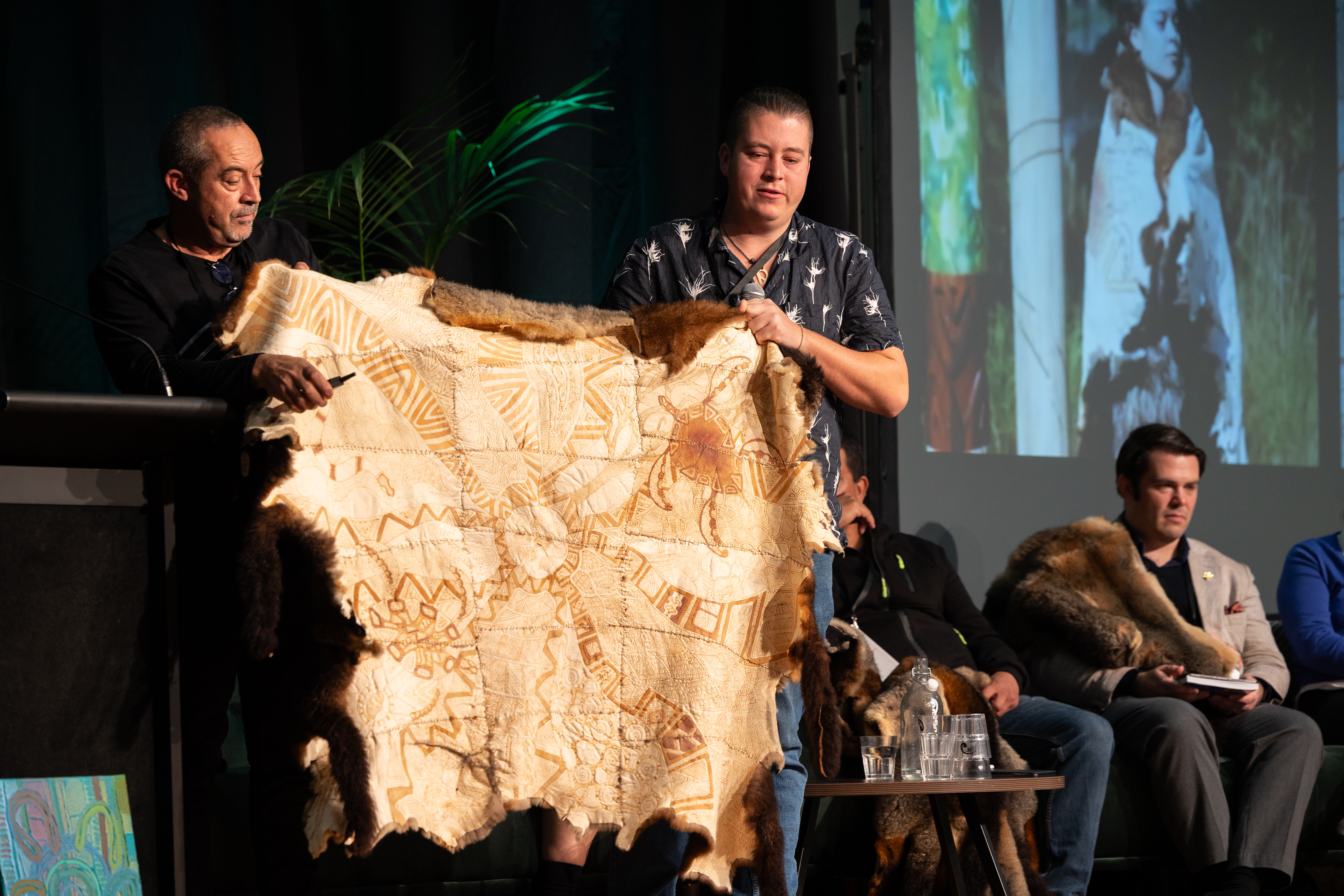
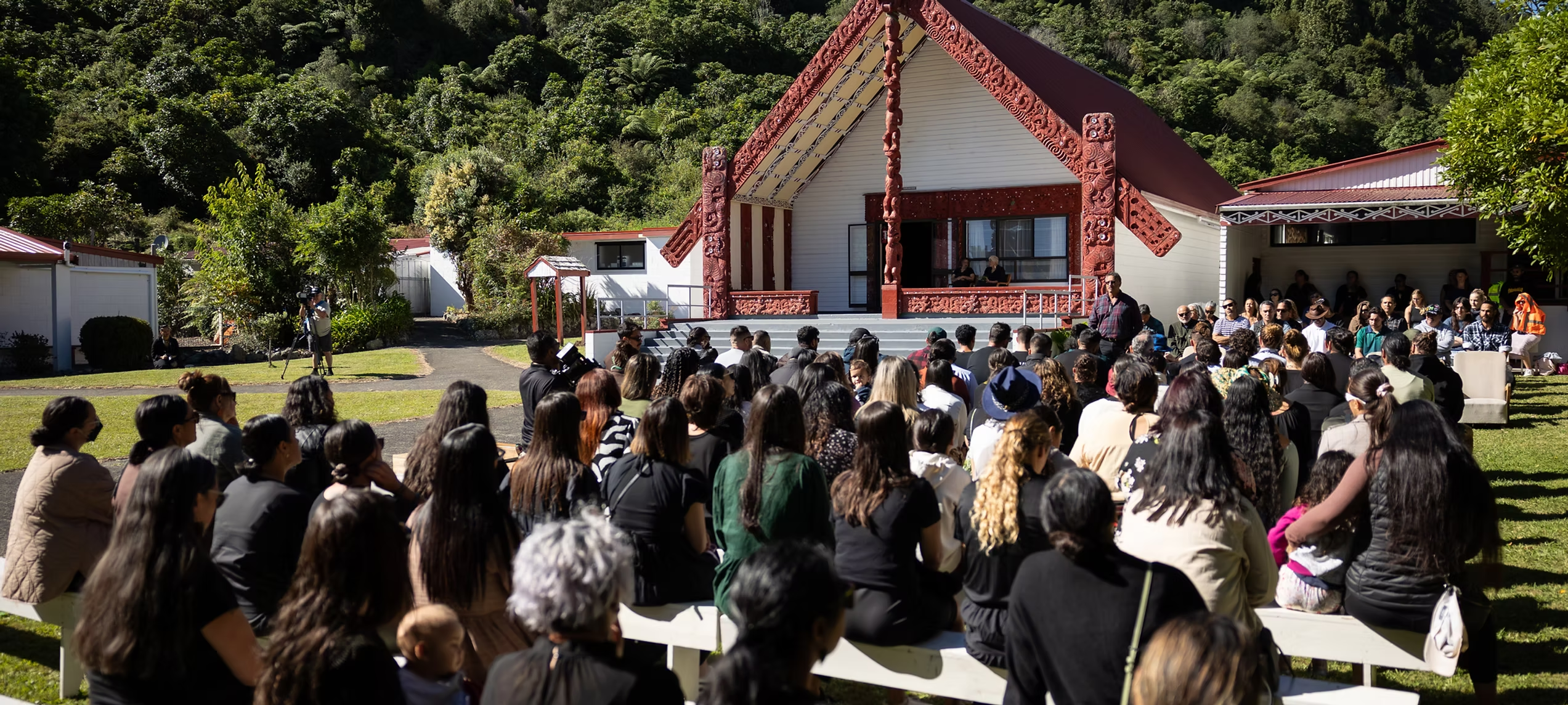
The second, and by far largest, wānanga in our Predator Free series was held at Pipitea Marae in Te Whanganui-a-Tara (Wellington) in early 2024. Titled Te Whare Māta o ngā Kirearea: (Re)storying the Possum this gathering explored the complex and evolving role of the possum, from taonga to colonial commodity, from pest to a catalyst for Indigenous collaboration.
The kaupapa for this wānanga was sparked, in part, during our first gathering in Ōtautahi in 2023, when a question shifted our thinking: “If possums are taonga to Aboriginal mob, what might it mean to return the skins?”
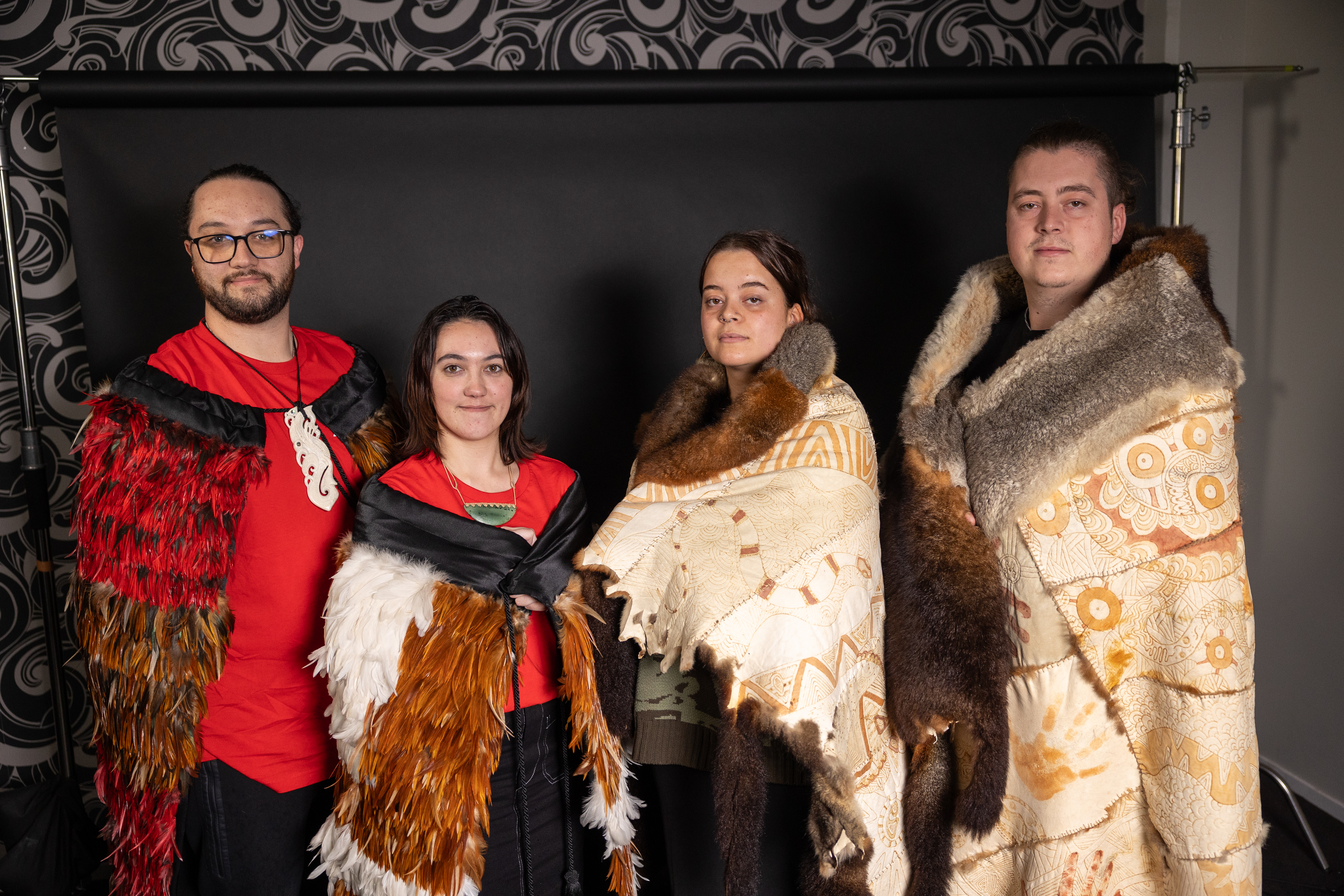
This question opened the door to deeper relationships and cultural exchange. By 2024, through our long-held relationship shaped by trust, care, and share visions, this idea became reality. At Pipitea, Māori kaitiaki gifted possum pelts to Aboriginal cloakmakers from southeastern Australia. Representatives of a Mob where possum-skin cloaks hold deep ancestral and spiritual significance, and where their making is an act of honouring and living in tradition.
For many of us, this was a moment of transformation. Māori spoke openly about the emotional and ethical weight of killing animals, especially when those animals are unwanted here but sacred elsewhere. In return, Aboriginal artists showed us how this burden could be turned into beauty, healing, and cultural restoration. The exchange was not just symbolic, it was an act of Indigenous reciprocity, solidarity, and resistance to colonisation.
This wānanga also created space for Māori-led Predator Free initiatives to share their own stories and strategies for managing the possum in Aotearoa. These kōrero pushed us to think about the possum not just as a pest, but as a site of relationship: a species that connects us across oceans, cultures, and generations of environmental trauma and revival.
This wānanga was widely covered in national media:
Supporting System Change: Wānanga for Non-Māori Predator Free Organisations
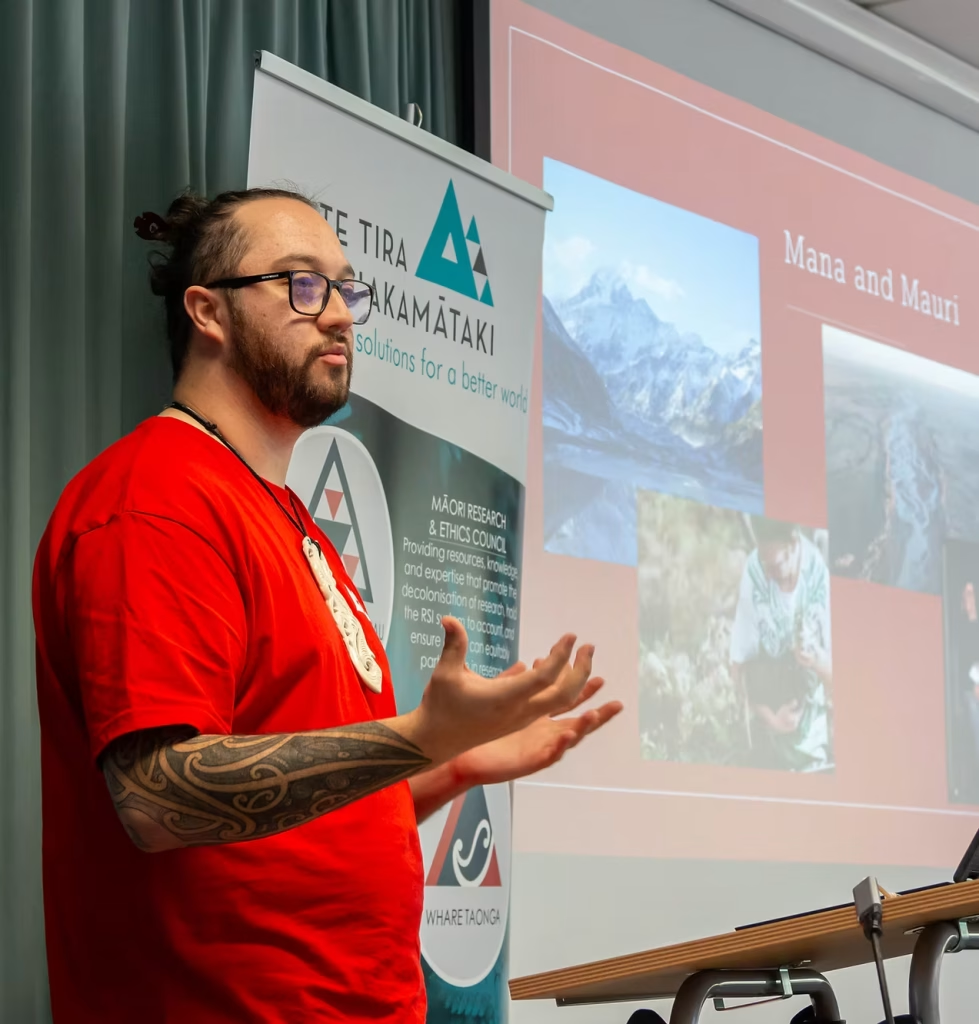
In June 2024, TTW hosted the third wānanga in the Te Whare Māta o Ngā Kīrearea series, this time it was designed specifically for non-Māori Predator Free organisations, including the Department of Conservation (DOC), Predator Free 2050 Ltd, Predator Free Trust, and Zero Invasive Predators (ZIP).
This wānanga provided a dedicated space for these organisations to ask questions, build understanding, and deepen their awareness of te ao Māori and its relevance to the Predator Free 2050 movement in a safe, non-confrontational, participatory manner. The goal was to support the creation of a more informed, culturally aware Predator Free system, where Māori can participate equitably and where mātauranga and tikanga are recognised and respected in practice, not just in principle, by upskilling the wider systems participants.
Over two-days, participants engaged in kōrero and learning sessions on:
- Te Tiriti o Waitangi and Treaty Settlements
- The Waitangi Tribunal and its environmental findings
- The history of conservation in Aotearoa and its impacts on Māori
- Key reports, concepts, and values in te ao Māori
- Structural barriers Māori face in the PF2050 system
This wānanga was not simply a cultural introduction, it was targeted system-level capacity-building. Participants left better equipped to engage meaningfully with Māori communities, understand obligations under Te Tiriti, and support the safe, effective, and ethical use of mātauranga in pest management.
“I hadn’t been aware of how the whakapapa of conservation in Aotearoa has developed in such a divergent way to a te ao Māori perspective. All that “protectionism”. It made perfect sense when [TTW] explained it, but I just hadn’t considered it before.”
Attendee at Wānanga for Non-Māori PF Organisations
Kura Reo Taiao
Environmental Language Learning Gathering
Te Taiao Speaks Te Reo Māori
To understand mātauranga Māori, Māori knowledge, we must also understand the language it lives in. Te reo Māori, the Māori language, is not just a translation tool, it holds and transmits the worldview and knowledge that shapes Māori relationships with the environment.
That’s why Te Tira Whakamātaki supported and championed Kura Reo Taiao, the first Māori language immersion experience focused entirely on environmental and pest management language.
Because embedded in our language are the gems of knowledge we need to confront the wickedly complex environmental challenges facing us today.
Why a Kura Reo for Predator Free?
The language we use to describe mātauranga Māori in the Predator Free space cannot be separated from the knowledge itself. To respect and use mātauranga Māori appropriately, we must also revitalise and strengthen the reo that expresses it.
Kura Reo Taiao was designed to do just that, create a safe, empowering space for Māori to deepen their use of te reo Māori in environmental and pest management contexts. It was about building confidence, improving fluency, and ensuring that te reo Māori is not only visible, but valued and integrated across the Predator Free 2050 movement.
Predator Free 2050 recognises te reo Māori as the indigenous language of Aotearoa and one of three national languages recognised in law. In support of its revitalisation, Kura Reo Taiao aimed to equip attendees with the tools, confidence, and cultural grounding to use te reo Māori meaningfully throughout all aspects of the PF2050 movement.
The First Kura Reo Taiao
Held from 1-5 March 2024 at Waikōhatu Marae, this inaugural Kura Reo Taiao was funded by the Department of Conservation through this programme, with additional sponsorship from the Biological Heritage National Science Challenge. It was a relaxed but powerful gathering, a space for Māori to simply be Māori, while immersed in four days of language, connection, and learning about and in the taiao (environment).
Interest was overwhelming. When first advertised, we received over 600 unique enquiries, and within just one hour of registration opening, over 400 people submitted expressions of interest. The 150 available spaces filled quickly, due in no small part to the exceptional calibre of our kaiako (teachers), some of the most respected figures in te ao Māori, language revitalisation, celestial navigation, and environmental knowledge. Our kaiako were:
- Papa Rereata Makiha
- Professor Rangi Matamua
- Herea Winitana
- Paulette Tamati-Elliffe
- Tūmai Cassidy
- Hinerapa Rūpaha
- Puke Timoti
Their presence brought immense mana to the event and inspired deep engagement from attendees, who were eager to learn about the environment through the lens of te reo Māori and mātauranga Māori.

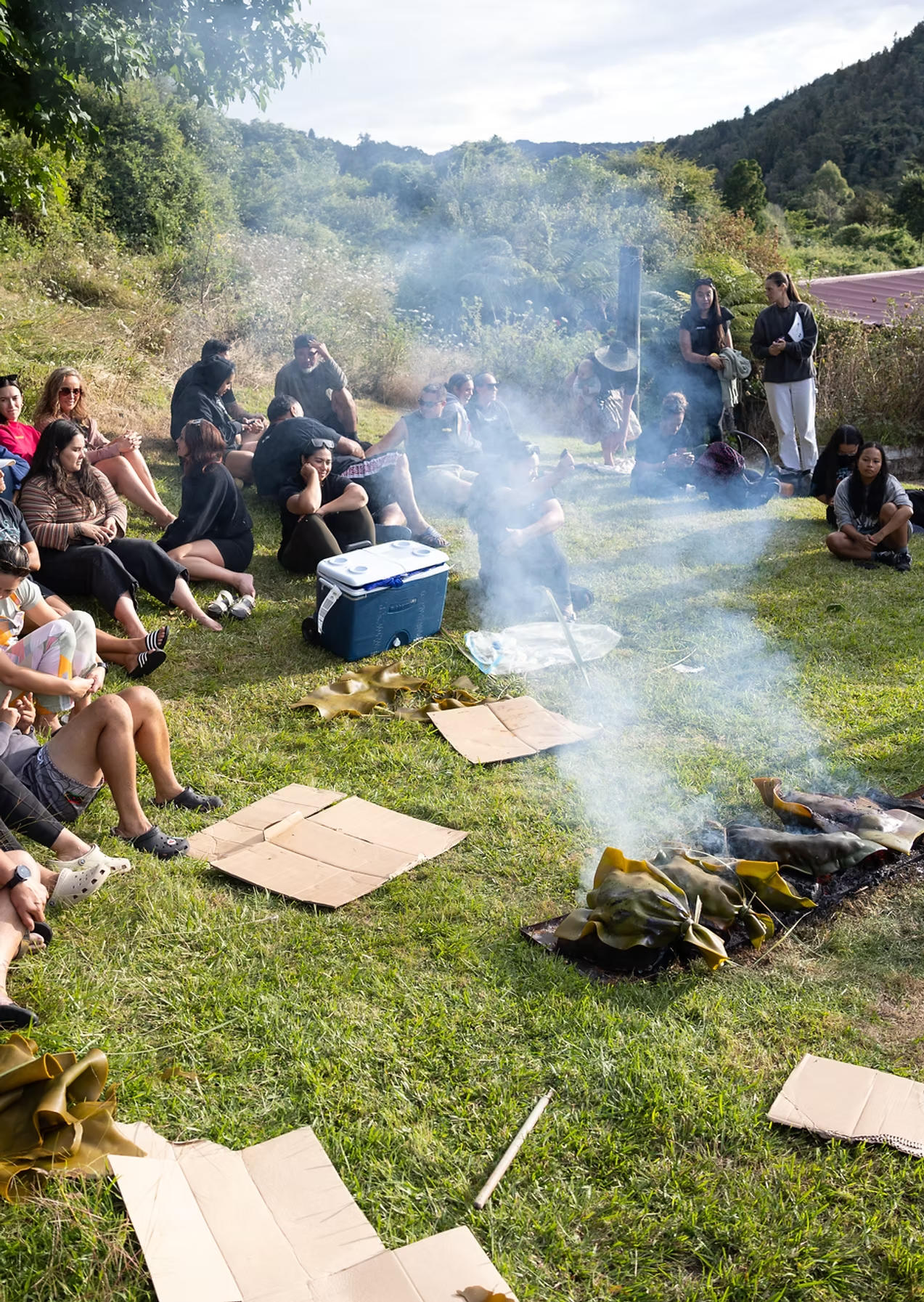
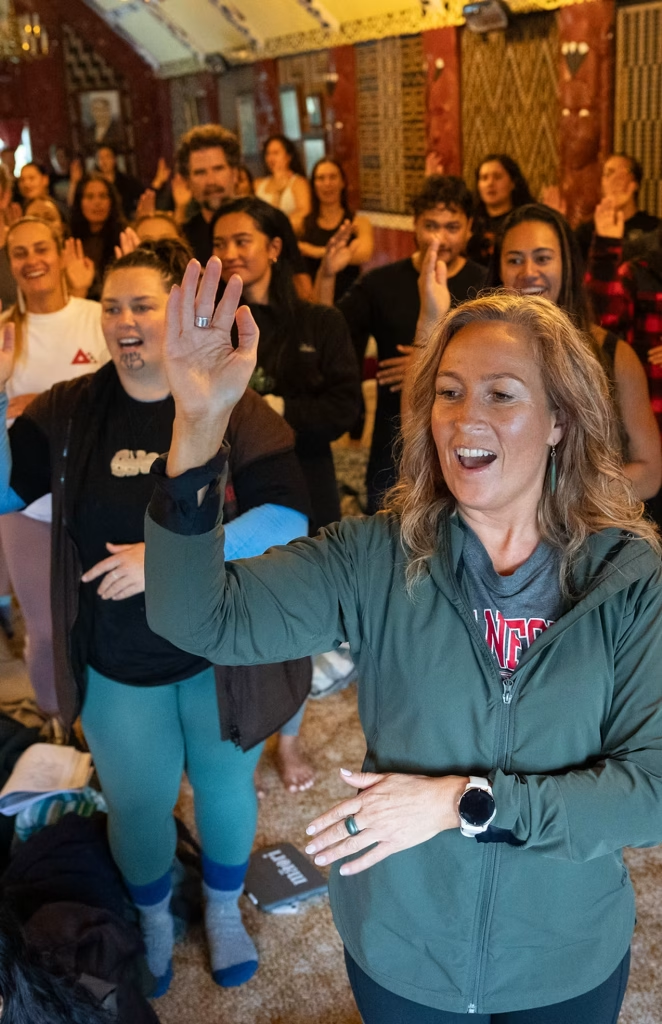
Over four rich days, attendees were immersed in te reo Māori, strengthening both their fluency and their cultural connection to environmental practice.
Participants were grouped according to their language proficiency, ensuring that everyone could learn at a pace that suited them. Each group rotated through sessions with our kaiako, who each brought their own unique expertise and environmental focus. These sessions included:
- Navigation, oceans and environmental observations with Hinerapa Rūpaha
- The night sky, Matariki, and star constellations with Professor Rangi Mātāmua
- Ngahere (forests), native plants and manu, and the role of fire with Puke Timoti
- Tikanga in the natural world with Herea Winitana
- Maramataka and seasonal indicators with Papa Rereata Makiha
- Mahinga kai and traditional food foraging practices with Paulette Tamati-Elliffe and Tūmai Cassidy
Through these rotating sessions, participants not only deepened their te reo Māori skills, but also learned how environmental concepts, values, and knowledge are expressed and maintained through language. The structure ensured learning was immersive, culturally grounded, and deeply relevant to the Predator Free kaupapa.
Within the PF2050 system, Kura Reo Taiao has elevated the visibility, proficiency, and quality of te reo Māori, showing that language is not just a communication tool, it is a critical foundation for Māori-led pest management.
The event attracted national media attention and, more importantly, sparked real action. Since the inaugural gathering, two more Kura Reo Taiao have been hosted, with a third is scheduled, all led by participants from the inaugural event, all within the TTW network, and partially funded by this programme.
For us, this is a true measure of success: not just a well-attended event, but the beginning of a movement. A movement where communities feel empowered to carry the kaupapa forward and create more space for te reo Māori within the Predator Free 2050 system.
What difference did it make?
To measure the impact of Kura Reo Taiao, TTW carried out pre- and post-event surveys with the 150 participants who attended. The surveys were designed to assess anticipated outcomes of the Kura Reo Taiao around language use, cultural confidence, and understanding of mātauranga Māori in the context of pest management.
In the pre-event survey, many participants responded with neither agree nor disagree, disagree, or strongly disagree to nearly all of the questions asked, a sign of uncertainty or lack of confidence (black dots in the graph below).
However, the post-event results showed a dramatic shift. To illustrate this, we grouped responses that selected agree or strongly agree and compared them across the two surveys. The graph below, shows there were many more participants agreeing or strongly agreeing with each statement after attending the Kura Reo Taiao (red dots in the graph below). The notable increases included:
- 95% felt comfortable using te reo Māori to talk about the environment in daily life (*up from 50% in the pre survey, a 45% increase)
- 69% understood te reo Māori words, sayings, or phrases related to pest management, trapping or hunting (up from 10% in the pre survey, an increase of 59%)
- 63% felt knowledgeable about the mātauranga Māori surrounding pest control (up from 8% in the pre survey, an increase of 55%)
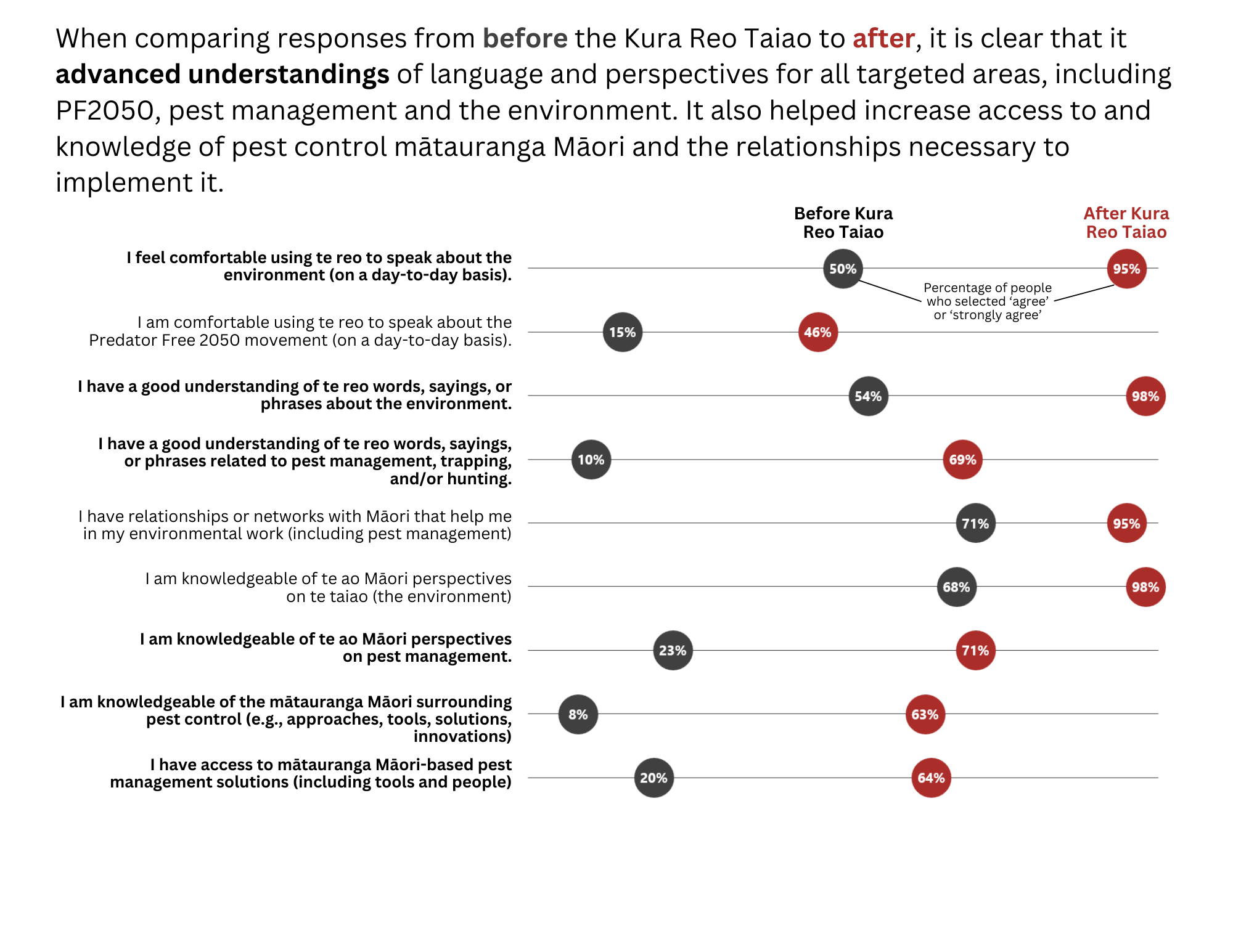
The results reflect a clear and significant shift, not just in language proficiency, but in participants’ confidence to apply te reo Māori and mātauranga within real-world pest management contexts.
This kind of measurable, values-aligned impact is exactly what Kura Reo Taiao was designed to achieve, strengthening both cultural identity and system capability in the fight for a Predator Free Aotearoa.
Predator Free 2050 Kāhui
Responsibility for the things that define us.
Predators have a devastating impact on Aotearoa New Zealand’s biodiversity, threatening not only native species but also taonga and high-value production species. While science plays a critical role in eradicating these predators, a truly effective and future-focused response must include Māori leadership, mātauranga, and tikanga.
To ensure this, Te Tira Whakamātaki helped establish the Predator Free 2050 Kāhui Māori – Ngā Matapopore. The Kāhui was formed to provide high-level, independent advice on how mātauranga Māori can and must contribute to national predator control research and strategies, and to ensure this knowledge is protected, respected, and used appropriately.
The Role of the Kāhui
The Kāhui was established to strengthen the PF2050 system by:
- Ensuring that strategic decisions are informed by the best available mātauranga Māori and scientific advice.
- Providing high-level recommendations on research priorities, coordination, and alignment with Māori values and knowledge systems
- Supporting the development of a national science programme that includes Māori leadership, tikanga, and mātauranga from the ground up.
- Advising the PF2050 Collaboration Groups and DOC programme office on how to safely and meaningfully engage with mātauranga Māori.
- Acting as a technical advisory group for projects required to work with Māori communities and knowledge holders.
The Role of TTW
TTW supported the formation of the Kāhui by:
- Writing the justification papers for the establishment of the Kāhui, the remuneration advice, terms of reference, and selection criteria.
- Drafting templates and governance documents (e.g., conflict of interest, confidentiality agreements, meeting minute templates, and agendas).
- Facilitating a rigorous recruitment process to identify 13 respected Māori experts, including tohunga and independent specialists.
- Administering the Kāhui during its initial establishment phase, ensuring it had both cultural integrity and strategic clarity.
The Kāhui included a mix of independent members, agency observers, and government representatives, and was recognised as a vital pillar of the mātauranga Māori workstream. At the end of the contract, the responsibility for the group was passed to DOC who, unfortunately, put the Kāhui on hiatus due to budget cuts.
Carrying the Kaupapa Forward
We believe this kind of group remains essential for a Predator Free Aotearoa grounded in partnership and equity. Below, you’ll find the templates and tools TTW developed to support the Kāhui. These can be adapted by others establishing similar governance or advisory groups within and beyond the Predator Free system.
We encourage others to use, adapt, and build on them, and to contact us if you’d like support bringing your own Kāhui to life.
Note: The highlighted areas you may need to change to better suit your circumstances.
Contact us for more details.

Governance Calendar and Information Template
Kāhui Meeting Minute Template
Conflict of Interest Form Template
Interests Registrar Template
Terms of Reference Template (PF2050 Example)
Letter of Appointment Template
Kāhui Agenda Template
Outcomes and Impacts from the Mātauranga Māori PF2050 Contract
Evaluating the difference we made
While outputs are useful to show the extent of the work completed by TTW on this contract, we do not believe they show what difference the suite of programming made.
To show this difference, we evaluated each event and the overall programme with a set of unique and common questions. This allowed us to respond to specific feedback while tracking the differences we were making over time. We designed post event feedback forms for each wānanga we held (170 total participants), conducted interviews with programme participants, and ran a pre & post survey with Kura Reo Taiao attendees (results of which have been outlined in the Kura Reo Taiao section).
This section combines all data to show the overall outcomes of the Mātauranga Māori PF2050 Contract. To us, the results clearly show the value of investing in mātauranga Māori in the PF2050 system.
You can read the full evaluation report here.
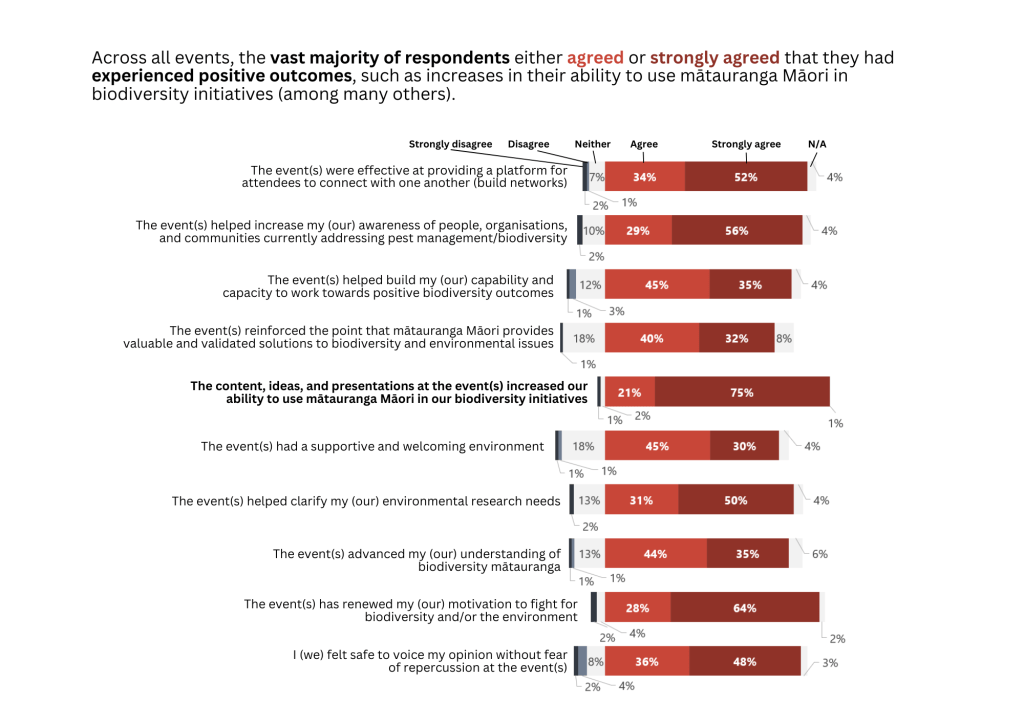
When putting the wānanga and Kura Reo Taiao feedback surveys together, a clear and positive pattern emerges. That is, the majority of the 170 respondents agreed or strongly agreed that they had experienced positive outcomes from attending the events (demonstrated by the red bars in the graph below).
Of note, 96% of all respondents either agreed (21%) or strongly agreed (71%) that the content, ideas, and presentations at the event(s) they attended increased their ability to use mātauranga Māori in their biodiversity initiatives. This is an important finding, as it shows that the various topics at each event served to advance and validate the use of mātauranga in the PF2050 system.
Additionally, evidence shows that 92% of respondents either agreed (28%) or strongly agreed (64%) that these events renewed their motivation to fight for biodiversity and the environment, further showing how the incorporation of te ao Māori is an appealing and exciting influence for those working in the PF2050 system.
Overall, the combined quantitative results from the events are overwhelmingly positive, an indication of the value mātauranga Māori can bring for the PF2050 system.
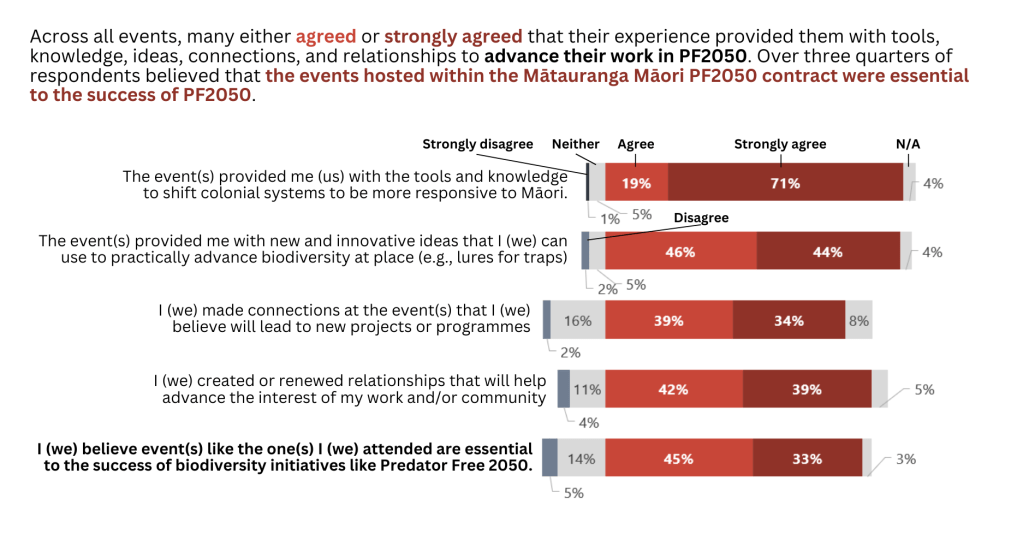
We also asked respondents to rate how effective the events were at providing the necessary tools to advance their own programming through systemic change, practical applications, and connections.
Encouragingly, and as the graph below shows, many respondents either agreed or strongly agreed that the events facilitated these outcomes for them.
Of particular note, a combined 90% of respondents agreed (19%) or strongly agreed (71%) that the events gave them the tools and knowledge to shift colonial systems to be more responsive to Māori.
78% agreed (45%) or strongly agreed (33%) that events like the one(s) they attended are essential to the success of initiatives like PF2050.
To TTW, this is a clear sign that there is a huge appetite for further investment in mātauranga Māori in pest management.
Through a series of interconnected workstreams, including Predator Free Whare Wānanga, the establishment of Predator Free Kāhui, the creation of Predator Free Kura Reo, and research on Māori data sovereignty, this programme has made good strides toward mātauranga Māori in PF2050.
The combined qualitative and quantitative data gathered from the various events highlight a significant increase in participants’ knowledge and motivation to incorporate mātauranga Māori in their pest-management and biodiversity work.
An impressive 96% of respondents reported an enhanced ability to use mātauranga Māori in their biodiversity efforts, and 92% felt renewed motivation to work towards the PF2050 goals.
The programme has not only strengthened participants’ knowledge and connections but has also challenged and reshaped their perspectives on pest control and biodiversity, particularly in relation to the cultural significance of species like the possum.
Overall, however, our evidence demonstrates the critical role that mātauranga Māori can play in achieving the goals of PF2050. When this work fosters a more inclusive, informed, and motivated set of individuals to work within the system, it is undeniable that entire country, and future generations, benefit.