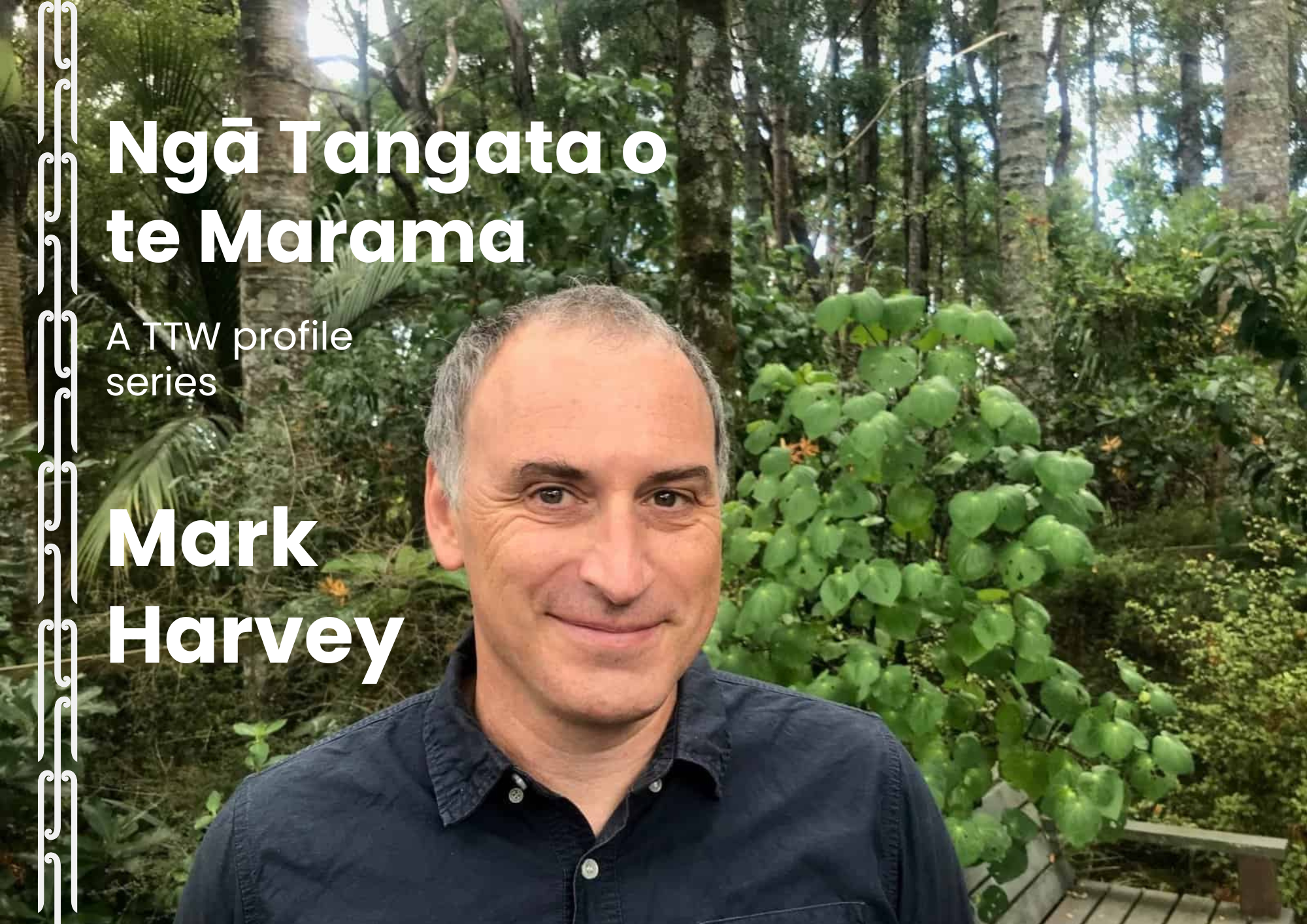
Ngā Tangata o te Marama | Mark Harvey
What does it take to bring people with you?
For Mark Harvey, that question sits at the heart of environmental work.
Science matters. Ecology matters. Policy matters. But none of it can hold if people feel disconnected from the places, relationships, histories, and responsibilities that make the work meaningful.
In this profile of Ngā Tangata o te Marama, Mark talks about forests, art, conservation, kauri, community action, colonial capitalism, Te Tiriti, wellbeing, and why environmental work needs to be more than technical fixes handed down from above. Again and again, he returns to the same deeper point. We cannot look after the forests unless we also look after each other.
This is a kōrero about connection, collectivity, storytelling, protest, public policy, and the hope that grows when people work things out together.

Can you tell me a little bit about yourself? Who are you, where are you from, and how would you introduce yourself to someone you’ve never met?
Culturally, I’m mixed. Taranaki Whānui, half Scottish, some and Portuguese and Welsh and English, and you name it, it’s in there. It depends on how far back you go.
I grew up in Tāmaki Makaurau, away from our Māori heritage. You could say I’m urban in that regard, and slowly I’m rekindling connections back with our own iwi. It’s not so easy being up here.
Here I am living in Tītīrangi and Te Wao Nui ā Tiriwa, being the Te Kawerau ā Maki name for this area, also Hikurangi.
I’ve got profoundly deaf parents. I’ve grown up around that. I’ve always been interested in conservation, even though I started my career in psychology education and moved over into the arts, creative practices, as a contemporary artist with around 30 years of experience, along with research in various approach disciplines, like social science and mātauranga Māori and te Tiriti related issues.
I’ve been teaching at the University of Auckland, Waipapa Taumata Rau, for 21 years, in creative arts across a range of subjects. In more recent years, I moved over into environmental stuff. Part of what I teach at the university is also around stuff coming from both sides of Te Tiriti. The arts practices I’m involved with have leaned more and more towards environmental things.
Forests in particular are of interest to me, but I’m not limited to that because I’ve done projects in forests and around waterway areas.
Living around where we are, I helped start a conservation area you could call pest-free or predator free. Its goal is about 1,400 hectares. Around here, we call it Waima to Laingholm. We haven’t given it a decent Māori name yet, apart from Waima.
We’ve been going for 10 years now. I set it up with lots of neighbours, and they’re all Pākehā, but we’ve always partnered with Te Kawerau ā Maki as soon as we knew they had interests in the place. When the rāhui was declared by them, we’ve always sought their guidance on it. That’s been around nine years of that.
Since we started, lots of other conservation groups around us have started as well. A lot of that came out of there not being local government support for the stuff that used to be in our area more directly. We just took things into our own hands, and since then we’ve grown and grown.
We also have voluntary high school kids who come and do courses through us and a partner conservation programme. Kids of all cultures, because it’s urban. That’s really important here, that rangatahi, our youth, are involved in this stuff. With conservation groups, even urban or semi-rural city-based ones, continuity is often a real issue when it comes to volunteers.
With these not specifically Māori projects, continuity is a real issue. So that’s a little bit about me. Research projects, you want to know about.
I’ve got a couple of rapid fire questions about who you are. Let’s start with your favourite movie of all time?
I don’t know if I have one. Many movies, and don’t like many movies. Anything where colonisers get their way, I don’t like them.
Are you much of a reader? Do you have a favourite book of all time?
I’ve read many, many things. I have to read for a living. There are lots of books that have stood out for me, but things that resonate with me are the ones where I go, yeah.
Linda Tuhiwai Smith’s Decolonizing Methodologies, that book from 1999, was a seminal one for me. It was that sense of, oh, it’s okay to be who we are and do what we do. That’s through work, not my pleasure. Well, it is pleasure. My work is a pleasure for me.
That one was very important, and it’s used by so many people around the world in these contexts. It’s useful in this space, I think, where te taiao, the environment, is part of who we are.
What would be your go-to weapon in the zombie apocalypse, Mark?
Forgiveness. Or trust. Trust and forgiveness. It depends, actually. Of course I would blitz the zombies. I’d get them. Forgiveness would be essential for working with the non-zombies. Maybe the zombies would come around. I don’t know.
Beach, bush, or mountain, Mark?
Bush. I’ve always had an affinity with the forests. As a kid, I’ve always loved them the most, the fun in them. I like all of them, but something about the forest is so obviously full of life. You can see everything being connected more.
Beach looks more barren. Mountains look more barren. But I can do more in a forest. As a kid, I used to run around forests with my mates, go bush bashing and shoot each other with wax pellets from our slug guns.
What would be your biggest pet peeve?
My biggest pet peeve is colonial capitalism that is ever dominant in our governmental politics, that prevents us being able to get on and fix all the damage we’ve done and move forward from that.
Colonial capitalism is the root of so much, including all the anti-Māori sentiment that’s out there, the selfishness and greed, and the myopic thinking. It reinforces colonial modernist notions of thinking that prevent us looking holistically and dealing with things holistically.
Let’s dive into that a little bit. What’s the solution? What do we need to do to make things better?
We need to look at wellbeing again as an essential thing in legislation. We need to look at future generations in all our government legislation. The Welsh do that. I was in Wales last year, and it’s not always perfect, but if you’ve got those levers in legislation, that can be a starting point.
Obviously, put Te Tiriti back in place. Actually, Te Tiriti, in terms of everyone’s responsibilities, especially the government’s, on the Māori text, the legally recognised text. Honour that. Allow Māori to run and control things for Māori. Don’t be scared of that. Educate people around how we can be inclusive through it, and how it allows for that. Everyone is included, not excluded.
Putting mana as a central thing around what’s of value, rather than financial stuff and GDP mentalities, would be a huge shift.
It’s not to say we shouldn’t have money, but it’s looking at reciprocity and koha, not hoha. That’s a summary. Setting up a system of koha, not hoha.
What karaoke song would you sing if you had to do it right now?
I would have to know the song. Old ’80s, bad ’80s anthems. Often punky and post-punk would be my favourite.
What would be your best life hack that you could recommend to other people?
Don’t work in the evenings and don’t work on the weekends. I usually try to, and it makes a difference for mental health. Lots of colleagues who don’t do that constantly look burnt out, and I feel burnt out if I don’t do that. Recharging and having things that take you away from it all, things that are not work-work, matters.
What is the one place on this earth that has really shaped who you are as a person?
Maybe where I live now, here in Te Wao Nui ā Tiriwa, what’s called the Waitākere Ranges. The challenges of getting up hills on my bike and caring for the place.
Out of everywhere, this has always felt like home for me, even though home-home is Taranaki, in a sense Scotland too. There are lots of homes and whakapapa. My first memories of going to the bush were here. My first memories of going to the beach were around here.
Growing up, it was quite a multicultural place where I think Te Tiriti has potential to be really worked through. There are aspects of it here where the locally recognised mana whenua, Te Kawerau ā Maki, are now recognised where they weren’t.
When I was a kid, we didn’t even know who the local iwi were, except learning about Ngāti Whātua in Central Auckland. This area is definitely that. The mix of people, it wasn’t a rich and poor area. We were basically working and middle class people interacting together. It felt like that growing up, especially down in the lower ends of this forest area.
On the whole, it was pretty straight up. I learned how to handle a tumble in a fight as a kid, so maybe that wasn’t great. But in high school, no one ever fought.
On the environmental side, this is kauri forest around here. There’s something about being around these kinds of forests that feels like home. There’s a magic about kauri forest for me.
What about Te Wao Nui ā Tiriwa shapes the way you see the world today? What about it do you bring with you now?
It definitely shaped my interest. I’ve gravitated back towards here. I grew up on the edges of it, so I wasn’t actually in the forest where we grew up, but I was always looking at this forest area and thinking, that’s magical.
The idea of forest habitat, the ecosystem, things being interconnected, it all aligns with te ao Māori. The symbiosis of life through the forest around here, to me, is how we work out in the world as people as well.
We’re not separate from the environment where we are, or from each other. Growing up in that working to middle class, multicultural area, the idea of looking after each other was shaped by being around our Pacific cousins and Māori mates. It influenced that idea of caring for others.
Growing up in my family, with profoundly deaf parents, had that influence too. We can’t look after the forests. We can’t look after anything unless we look after each other. We’ve got to do both.
In my view, getting rid of poverty and those kinds of things, we’ve got to do that. To bring people along with us around environmental issues, we’ve got to look after them. Otherwise, people are too stressed, too selfish, or they become divisive, like in the current political situation running our government.
Do you remember your first memory from being outside, Mark?
There are lots of memories of being in the garden, in the mud, doing gardening with my mother in particular and pretending to turn our garden into Rotorua by putting a hose in there and watching the bubbles go.
And then being in the forest. My parents would go camping out in the bush, in summer camps. I had one adult’s big white sand shoes on, and I had a snorkel, and I was walking around. That’s probably one of my first outdoor memories.
Was there a particular person or group of people that made you pay attention to the environment around you?
My dad used to go pig hunting, but I was never part of that picture as a kid. We had uncles who were all farmers, and I loved that stuff, being outdoors.
It was a whole mixture of things. School trips, going out to the forest as a little kid, walking through, going on big walks, movies with adventurous forest scenes. All of those things made the forest magic and mystical to me.
From personal experiences to pop culture, it all made the forest thing. I also watched lots and lots of conservation programmes as a kid, documentaries from here where people were saving the native black robin, the kākāpō. For me, that was amazing. I was so excited.
David Attenborough, Jane Goodall, even though I don’t always agree with her around population and stuff, hanging out with the gorillas and the forest and things like that, all of that inspired me in lots and lots of ways.
The stuff around the black robins and the kākāpō, I’ve since got to know one of the key conservationists involved with all that. He’s an old man now. It was very exciting to have that link to people who went out to the Chatham Islands to rescue those birds.
There have been lots of directions of inspiration, even though I was also inspired by the arts and other things in terms of my career. What I focus on is the people side, the social, the human dimensions of the environment, even though I do conservation stuff myself. I do also trap and help organise that stuff.

Can you tell us what you do for work? What do the human dimensions of the environment look like in the big picture and day-to-day?
My work is only partly that, unfortunately, because I’m still in the School of Creative Arts. In the course we teach, we’re looking at te ao Māori as a founding thing in that course, and how essential that is right the way through it.
Biological science and ecological science are only part of the picture. We need people to be engaged, and we need to engage with people’s values, work with people and empower people. Otherwise, people can divorce themselves from valuing conservation and environment stuff. It’s fundamental.
Right now, there’s a whole big anti-science movement out there in various ways, from human diseases to pest control and kauri dieback. So, I’m interested in what it takes to bring people along with big issues like that.
Politicians often fail when people don’t feel like they’re being brought along, listened to, empowered and valued. I think that’s the same with environmental and conservation issues. And it differs with the communities we’re working with.
Iwi, hapū interests need to be met, of course, and tangata whenua need to feel their values are valued too. You can’t win everyone. There’s always going to be people who are like, ‘Oh, whatever.’
I saw some survey recently about people around here. It might have been one of our Mobilising for Action research projects, where the majority of people who live in this area, maybe 80 or 90 percent, something high like that, really care about the forest and living here. They love living here.
Maybe about 51 percent said they try to do something, but not a lot. Only about 2 to 4 percent were hardcore committed on a daily basis, or regularly doing stuff, and aware of the complexities of it.
How do we get people supporting this stuff who don’t? How do we get them feeling empowered to want to do things around this stuff? How do we educate them? Those questions are very important to me. It’s science communication, but it’s more than just that.
I mentioned empowerment. There’s mana motuhake for Māori in there, honouring that. There’s helping people realise that ecology is essential in our lives, and how essential that is for health and wellbeing. That’s all part of it.
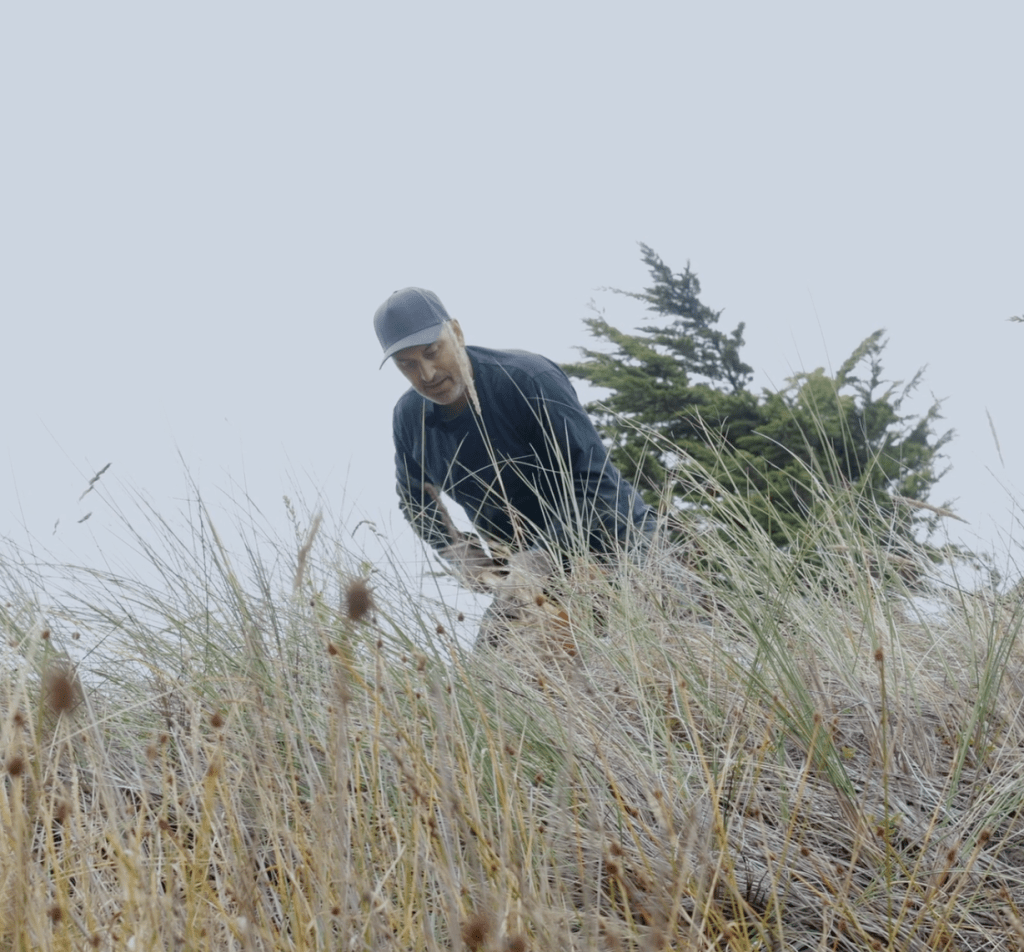
For me as an artist, before COVID I was starting to engage with environmental issues. I was involved with protest actions here and there, where the odd neighbour or two in our area were trying to chop down kauri trees.
I was part of the Save Our Kauri campaign that made international news around 2015. Then again, I can’t remember, 2016 or so, we managed to save that kauri from being chopped down, although there were other complexities around it. I was just one of many.
There was a moment when the artist from Te Kawerau ā Maki, Charlotte Graham, had made posters through The Kauri Project, and we held those up instead of protest placards. There were probably about 30 of us neighbours on the street, all holding them up. The tree choppers drove up to us, then just reversed and left.
The arts have a lot of uses, but for me, engaging with art and ecology, and awareness around this stuff, was always interesting. I got co-opted into joining Mobilising for Action, which was National Science Challenge funded around the human dimensions of kauri dieback and myrtle rust.
I brought in a whole bunch of others, curators and researchers in various ways, Māori and Pākehā. We commissioned, I can’t remember, maybe 12 Māori artists in the end. It was nine to begin with, around how they might engage with their communities towards empowering, educating, and giving space for communities to do their thing.
We commissioned documentaries, for instance, around Graeme Atkins from Raukūmara, Ngāti Porou area. It was called Mate Tipu Mate Rakau. And there was a whole lot of other things.
One project involved Tania Ruka. Her mama created a karakia for myrtle rust. So it engaged even with tikanga Māori and things as well, which was really exciting.
Through that project, I got co-opted into being a co-lead in Mobilising for Action. It was Māori and Pākehā-based projects around the human dimensions. That was really important to me.
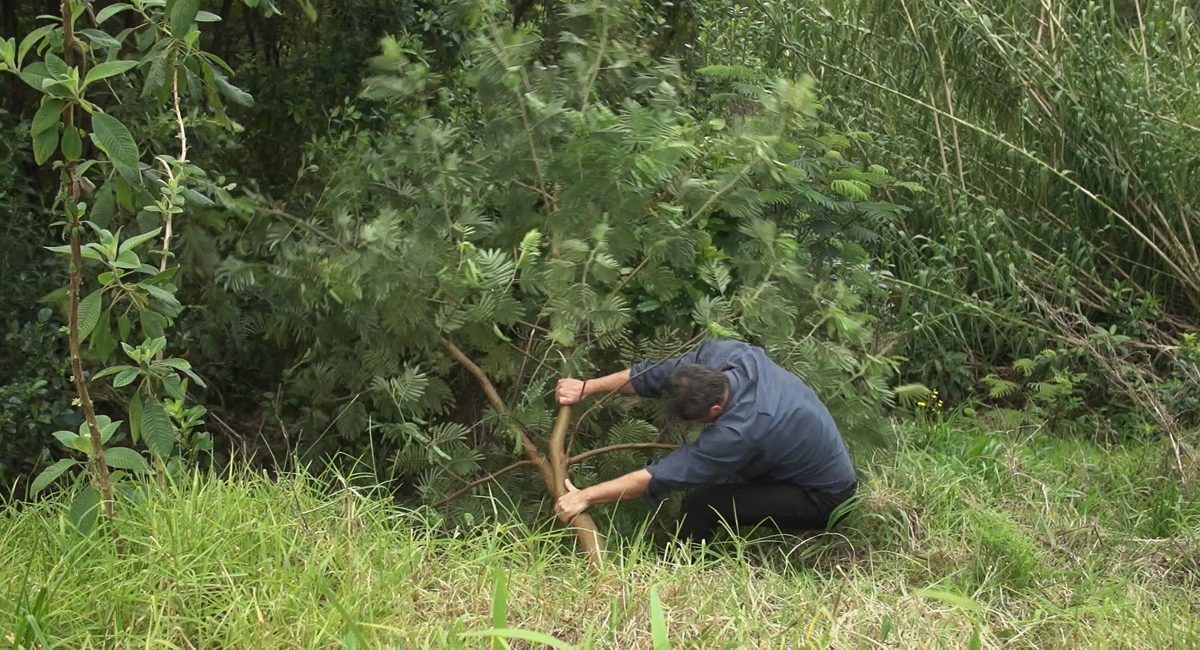
When we think of pest control, we often don’t put kauri dieback and myrtle rust into that. To me, those are essential. Pest control is not just mammalian. It’s insects, plants, species and pathogens as well. We did heaps of stuff there, and that was very exciting for me to focus on.
I’ve also done a project with one iwi where we focused on removing invasive plant species around their waterline and the beach and putting it back on State Highway 1. That took five years. A very cheeky project. It’s part of an exhibition about to be shown at Adam Art Gallery. The work is called Wakahokia.
In a lot of projects, if you can bring people along with it, maybe it can sustain itself. There’s often a risk with voluntary conservation projects, as I hinted earlier with the locals around here, that interest is there, but it dies out. It peters out. I think that’s like that with our government.
Another aspect of what we did was trying to influence public policy where we could. We involved Auckland Council and local schools. This is in Mobilising for Action. We involved local council with local schools around how we educate and empower local communities around why rāhui are in place in kauri forest areas.
As happens so often, public policy is decided through a top-down process. Rules are put in place about certain areas. Some of the local community might know at first, but then they forget very quickly.
One learning from working with people is that we can’t just stop. We have to keep going. We have to keep working on stuff together. Otherwise, we can forget very quickly around a lot of these issues. Being reminded of why and what it is becomes very important.
That’s why things like tikanga Māori are quite useful in Māori contexts. In non-Māori contexts, that stuff doesn’t exist. So how do we keep that education going? Through the arts, documentaries, public forums, consensus-based decision making and co-design with locals. All of that is really important.
As a concept, a word and an action, what is conservation and what should it be going forward?
The idea of rāhui was invented by Māori long before anyone else, and conservation per se, I would argue, is something through that and trying to get us in balance. If it existed in our European context, I bet it did, but that’s long lost since before Roman times, probably.
Embodying Te Tiriti through allowing Māori to bring in Māori knowledge, mātauranga Māori, is definitely a big learning. I mentioned strategies around how we keep people going, how we keep people engaged, how we make it relevant for people, and how we make things have mana.
Like the protest campaign years ago, Save Our Kauri. People could identify with that because it was kauri. If it’s something they can’t identify with or see, it’s very hard. Climate change is hard for people to identify with often. They can’t quite see it. It’s not a tangible object they might identify with.
Hearing people’s stories can be really helpful. Taking people into the place, getting them to experience what it is, and seeing stuff for themselves can help them learn it.
Another learning is how we build collectivity. How can we be together? Getting us to be together and working things out together can be a major part of building optimism. With a lot of our kids, especially non-Māori kids we work with, there’s a lot of pessimism about biodiversity decline and these issues.
When we started looking at strategies and developing strategies with them around how we might educate people, hope started to build more. The idea of working together and working stuff out together can’t be underrated in this space. It’s fundamental, and it’s very often ignored by central government.
It’s what needs to happen in public policy. I’m not saying we can undermine the science, because we need to give space for that too. It’s about getting everything balanced, working with collectivity, collective decision making and co-design. That’s a huge learning for me. In Māori spaces, that’s pretty obvious to a lot of people because they live through that.
What is giving you hope right now, Mark?
Our students, our youth and our local community doing this stuff, the people on the ground, they give me hope big time.
All the conservation groups that connect through the Māori Biosecurity Network, all the local non-specifically Māori groups out there doing things, they give me hope big time. The potential that our youth have, where they can go, and looking at alternative models to where we are now in terms of colonial capitalism gives me some hope.
But our local communities on the ground doing stuff together, and being there for each other, is where it’s at in my view.
