
Ngā Tangata o te Marama | Valance Smith
Some kōrero are about the work people do. This one is about the relationships that make the work possible.
In this profile of Ngā Tangata o te Marama we talk to Valance Smith. He chats to us about what it means to be Tiriti-anchored, not just Tiriti-led. For him, Te Tiriti is a relational practice. It asks people, teams, and institutions to think carefully about trust, alignment, responsibility, and what honouring Te Tiriti looks like in each particular context.
This is a kōrero about anchoring the work properly, building relationships that can hold weight, and knowing who you are aligned with before the hard parts begin. Enjoy.

Valance, can you tell us a little bit about yourself? Who are you, where are you from, and how would you describe yourself to someone you’ve never met?
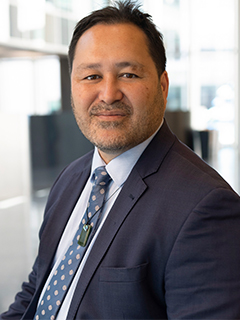
I’m Māori, from the two tribes of Ngāpuhi and Waikato. I grew up in South Auckland and still live in South Auckland. I currently work at AUT, the Auckland University of Technology. My current role is Kaihautū Tiriti – Tiriti Strategist for the university. My responsibility is to ensure, through uplifting relationships, that all of our whānau, our staff, and our core plans, strategies, and projects give meaningful, authentic expression to Te Tiriti o Waitangi.
It’s something I do enjoy. Universities and organisations like to coin the phrase Tiriti-led. I prefer whanaungatanga-led and Tiriti-anchored, which is where that relationship piece comes in. A lot of the discussions we have require building good relationships. Through trust and whanaungatanga, it’s about reconciling the space between what honouring Te Tiriti looks like within each individual context, and there are a whole vast range of contexts.
I’m not an expert in their area. My role is to reconcile that relational space. And you need whanaungatanga to do that.
What sort of background do you have? How did you find yourself in this position?
I was really good at complaining, and complaining in a way where people would probably pay attention. I don’t regard myself as being a Tiriti academic or expert, but I’m confident enough to hold this space to anchor and ground me in having these conversations. Things weren’t going particularly as I’d like to see them here at the university, maybe about 10 years ago. So I started exploring what’s the potential? What are the possibilities if we were to authentically embed Te Tiriti in our organisation? What might that look like?
That led me to assuming a position of Assistant Pro Vice-Chancellor Māori Advancement, under the guidance of our Pro Vice-Chancellor Māori, Professor Pare Keiha. I was charged with the responsibility to explore what implementation might look like. With that came a lot of complaining and respectfully, going several times to the ‘principal’s office’, which was our VC at the time.
But in a real relational way. These are the issues, but also I think these are the solutions. One thing led to another, and then our Te Tiriti framework, Te Aronui, was launched in 2023. We’re still a toddler in this space, but I also acknowledge all of the efforts from Māori and non-Māori staff prior to 2023, enacting Te Tiriti o Waitangi in their work without really having any directive. It wasn’t embedded into our strategy. It was really off their own efforts of social justice and the right thing to do, of being tika.
Now we have a framework that informs our overall strategy, core plans, and enabling plans. My role is ensure they align with our framework. That’s how I got into this mahi. I come to work every day, I turn up and I go after whatever needs to be done, its a hugely rewarding job.
Let’s pretend you wake up on a Saturday morning, it’s sunny, and you have nothing planned. What do you and your family go and do?
We go to a place called Maraetai. Maraetai is the beach about 25 minutes away from our house in Ōtāhuhu. It’s also the ancestral lands of my wife and, as such, my children.
We set up camp there. We have our trolley, we take our little burner, sausages, the paddleboard. That’s what we always want to do. We always want to connect with nature.
Recently, we had a couple of plans to go up north. One was to go down to Marokopa, a remote settlement down in the Waikato, and both of those were rained off. We get really upset when we can’t do those things, which is connect with te taiao, connect with nature. It’s essential.
We pivot, of course, but to your question, we connect with nature, connect with te taiao, and ensure that our tamariki also connect. That means no phones, no devices. Take them to the rock pools, take them for a bushwalk, but not just wandering through the bush without actually talking to the bush, talking to the ngahere, having a karakia, sharing some of the different rākau, the different plants that I’ve only just learned, to be honest, with my time with Te Tira Whakamātaki. That was one of my strong drivers for being a part of our project Te Reo o Wanui o Tāne.

I’ve got a couple of rapid-fire questions for you. What’s your favourite movie of all time?
The Empire Strikes Back. I went to see Star Wars when I was very young, and I remember loving it. When I couldn’t go back and see it a third time, in the ’70s, I was crying in the middle of our main street in Queen Street.
I saw Return of the Jedi when I was 10, and at 10 years old I started to really appreciate movies and what they actually meant. But out of the trilogy, The Empire Strikes Back is the best one. I saw that on VHS many years later. It’s got all those good tropes in there. Good pacing. I like it.
Favourite book of all time?
Tough one. The book that I would often read as a child is The Lion, the Witch and the Wardrobe. Between that and Fantastic Mr Fox, those were the two I would constantly read as a child.
As an adult, I was introduced to The Whale Rider, and I really enjoyed it. I can remember reading The Whale Rider and the imagery was so clear that I was imagining the whale and how things were unfolding.
What’s your least favourite chore?
Cleaning the toilet.
What’s your go-to karaoke song?
My go-to karaoke song would probably be, although I’ve never sung this before, Don’t You Want Me. I’ve dreamed I would sing that. I don’t do karaoke. We went up north on the weekend just gone, and I stayed at Kerikeri the night before so I wouldn’t have to do the big slog. I went to the local bar to watch the league and there was karaoke there, and I was going, “Now’s my chance. No one knows me.” But I didn’t.
Whenever I hear those ’80s songs, I go, “That’ll be a cool karaoke song.”
What is one app on your phone that you should probably delete, but won’t?
Probably Facebook.
Pineapple on pizza, yes or no?
For me personally? Yeah, I don’t mind it.
What’s your go-to hot take?
Leveraging AI for te reo Māori revitalisation. A lot of our Māori communities are, for whatever reason, resistant to using AI. Some of those reasons are Māori data sovereignty and cultural integrity of te reo. Many LLMs are very culturally biased against Māori worldviews, and it just hasn’t served our communities because of those things.
There’s another dimension though. It’s moving so fast, and there are a lot of unknowns. Our young people are adopting and using AI for various reasons. So it’s not the adoption curve that we need to address. It’s the trust curve, it’s the judgement curve. I think that comes with education. There’s a piece there where we can educate ourselves, our communities, my own whānau, to a space where if we use it responsibly and ethically, it can actually support some of the dreams and aspirations that we want for our whānau and communities.
One of those is te reo. I’ll use this example. This is what shifted me, because I was like that as well. Here’s me at AUT, putting charters and policies together about ensuring indigenous data sovereignty, Māori data sovereignty, intellectual and cultural property, and so on. You need to put these technical guardrails in place. That’s still constant.
But I have two older brothers. One recently turned 60, the other one’s 58, I’m 53. We celebrated my eldest brother Rodney’s 60th last year in November. I was the MC. My 58-year-old brother, Steve, has never been interested in te ao Māori or te reo. He’s not anti, that’s just not him. Mid-year last year, he sent a cryptic text saying, “Boy, what’s our whakapapa?” And I went, “What do you want to know that for? That’s a new one.”
So I responded, and when we got to the 60th birthday, I opened the floor and said, “Anyone else want to say a few speeches?” My brother Steve got up and delivered this seven-minute kōrero all in te reo.
I was going, “This undercover guy.” Later on I had to talk to him. I said, “Boy, what was that? You did a choice-as mihi. Where’d you learn that?” And he goes, “ChatGPT.”
That explained it, because as he was talking, I was going, “I wouldn’t have said it like that,” or, “I wouldn’t have used that word. I would’ve used another word.” But 80% of it was on point and the other 20% was, “Don’t use that.”
It shifted me. We need to ensure we protect mātauranga Māori, Māori data sovereignty, and the cultural integrity of te reo. We need to do that. But there’s something in the experience with my brother that made me think we also need to be able to leverage this power. The value proposition of ChatGPT or AI is speed, but speed is a byproduct of accuracy, of integrity.
Why that is a hot take is because in the circles I’m in with reo exponents, the vast majority are no. It’s a tool that might overtake us. It’s wrong sometimes. Yeah, but there’s got to be something in there. So, my hot take would be ethically and culturally safely leveraging AI for te reo Māori revitalisation.
Not even AI as a tool is something those circles would accept right now?
Not now. But see, that’s the judgement curve. That’s the trust curve. This is the change management curve. Understanding where people are at on the spectrum and being able to communicate in an uplifting way that might shift the dial for them.
What is your first memory from being outside? What do you remember about it?
It’s all bushwalks. My mum loved me dearly and probably understood that I didn’t have a male role model in my life. Every weekend she would send me off to my Uncle George’s, the best person you can send someone to.
He would often take us camping, his five kids, his wife, and the extended family, and I was the random little person who would tag along. That happened from the time I was seven until I was a teenager, for seven years solid.
We would always connect with nature. Nana would take us through the forest and go, “Oh yeah, rangiora, a very nice name, was the toilet paper that ancestors would use.” Those types of things, I was learning when I was seven. Mahiwhai, the string games, weaving flax. I can’t do any of that now. Tāniko, what a cool thing to be a part of. A lot of that was out in the country. That was my first experience of actually going, “Oh, there is a thing called the ngahere.”
Do you think it was that experience that inspired you or made you pay attention to the world outside?
A deep appreciation and connection to it, yes. But he wasn’t explicitly signposting that. I think he was just creating the situation, the circumstance, and the environment for all of us kids to explore and find our own way in that space. Had he not done that, I would not have had that opportunity to explore and navigate that space. So I’d say absolutely yes.
All my favourite memories now are with my kids, taking them on bushwalks, exactly the same. This is what’s worked for me, and I’m pretty sure it’ll work for you. Let’s go to the beach. Let’s go for a bushwalk. Let’s go to the rock pools. Let’s do all that cool stuff.
This week has been the first week none of our kids have touched a device. They have watched maybe three hours of television over the whole week, and it’s television, not YouTube, not little Netflix series. I want them to watch the ads. Not for the ads, but I want them to shift away from things having to be fast, where you can swipe.
My youngest one’s six. He’d watch these Mikey and JJ videos and have it on times two.
So he can get through it fast. We need to slow down, man. We’ll see how we go. Even something as simple as Shaun the Sheep, which I think is harmless, is still on a device. I want them to get away from devices.
That also means Mama and Papa have to get away from devices. It’s been good for all of us, and I’ve seen a real change in behaviour. When we catch up next time, ask me how it’s going.
If you had to pick one place in this world that shaped who you are as a person, where would that be?
My secondary school: a Māori boarding school, boys, 1986 to 1990, third form to seventh form. That definitely shapes who I am today.
I grew up in South Auckland. I knew I was Māori, and to be honest, there was a degree of shame that came with that. I remember when I was 10, we were asked to fill out a census card for 10-year-olds, and I picked European. There were all these little boxes: Asian, European, Pacific Island, Māori. I was going, “I’m staying away from that Māori one, man.” I am European and I’m Chinese, but I definitely didn’t pick the Māori one.
I also grew up in a period where, sprawled across corrugated iron fences in South Auckland and Māngere, was the slogan Māori dom is boredom. As someone who was easily influenced by what they saw, it wasn’t cool.
That was reinforced in the household where no one spoke te reo. We weren’t anti-Māori. We’d go to tangihanga and do all that. That was really my only connection. No one was saying, “Don’t be Māori.” But as a young child, that was my outlook on life.
Once I got to college, things shifted in a strong way, in a staunch way. I’m staunchly Māori. Those friends, I see all the time now. Yesterday, when I was up in Pāwarenga on the weekend just gone, I mentioned a couple of friends who have passed away, close friends of the community who I went to school with. Easter weekend, I hung out with two of my very close friends from school as well. And even yesterday, one of my really good friends, Dr Lance Sullivan, was just catching up on Messenger.
So staunchly Māori. That was definitely not part of my purview or worldview before I went to Hato Pētera College.

Do you remember a specific moment where you felt that shift, or was it a slow march over time?
It was probably the first day of school. It’s a boarding school, so it’s a huge shift from what I’m used to. It was karakia at night, karakia for kai, waking up first thing in the morning at 6:30, karakia within our little groups. I was surrounded by other Māori boys as well.
Doing kapa haka for the first time in my life, being mentored by one of the exponents of kapa haka, that was all new to me. I just fell in love with it. That’s why I like singing waiata. That’s why I picked up the guitar. That’s why I compose. Who knows? I might’ve been in the New Zealand Warriors league team if I went to another school. That would’ve been fine, but I’m glad I went to the school.
As Kaihautū Tiriti, what keeps you going when there’s resistance, or when the work feels slow or hard?
It’s being very clear about what the objective is, what the kaupapa is. We have to be kaupapa-driven, purpose-driven. I’m very clear about my own personal kaupapa, and it’s around aligning that to. Am I in an organisation that supports my own personal values and vision that I want to see for my mokopuna?
That’s what keeps me going. My role here is constantly evolving through the nature of what I do, and sometimes that can be unsettling. But then you focus on what you’re grateful for. When you focus on what you’re grateful for, your mood changes and you just go for it. That keeps me motivated.
I have a 10-year plan for my son, but I don’t say that selfishly. I say that because I probably represent a lot of mamas and papas out there that have a seven-year-old, and one day they might hit the shores of AUT. My responsibility, therefore, for my son and for all of our mokopuna is to ensure that not me, but our entire team and university, creates a space for Māori to succeed as Māori here at AUT.
I wake up in the morning and think, what a cool kaupapa to be a part of. This morning I woke up and went,
In your life right now, in work, wherever you want to draw from, what is giving you hope?
There are a lot of people in our community doing good work, a lot of people who are not only Māori, who are really fighting for social justice. I say that within the context of our current political landscape.
I also know I’m in the right place in terms of work, because as a Crown entity, while we’re an autonomous organisation, we still need to respond to government policies and strategies, yet we are saying no to that. That’s coming from the top. That gives me hope. I say that proudly whenever I talk to people. I think that becomes our value proposition for our students and for the communities who want to engage and partner with us.
So that’s what gives me hope.
Any last words?
Yes. I want to tell you a story about the Tigers in the NRL.
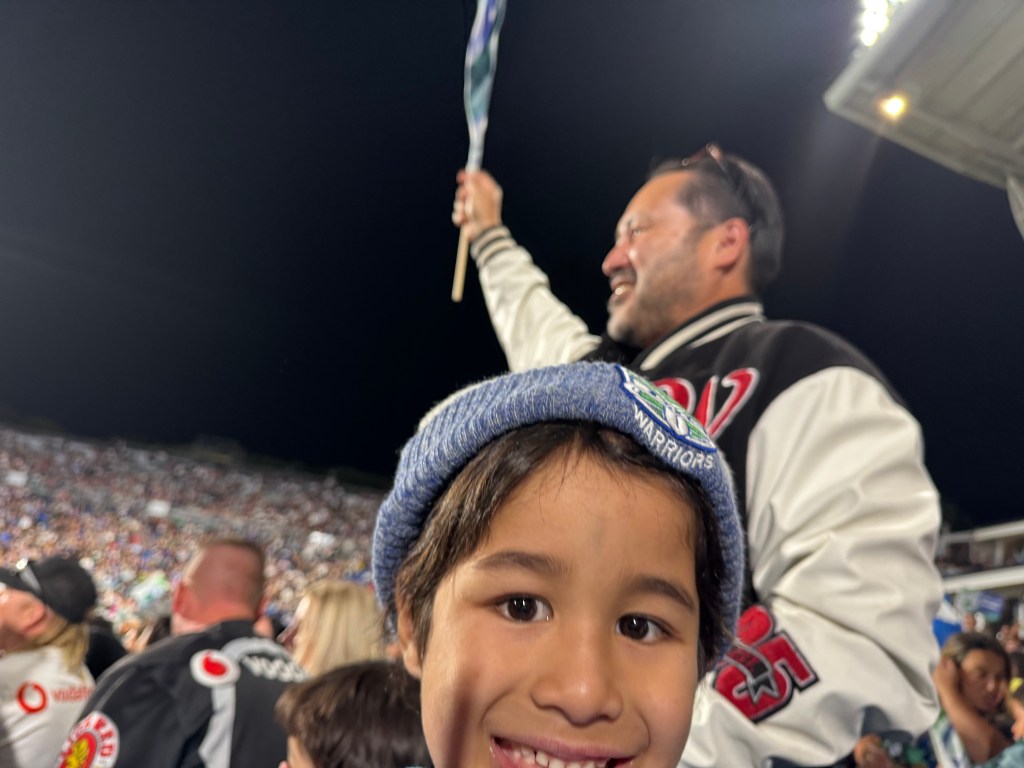
I went to the first game of the Warriors on the 10th of March, 1995. I’ve been a supporter of the Warriors. I have season tickets. I take my two boys to the Warriors all the time. They love coming to the Warriors, four and six. They get the hot dogs, shaved ice, popcorn, donuts, and they do everything but watch the game. They still want to come, and they’re running all over the place. I’ve got to go home to watch the game. But I love going with them.
There was one time when their cousin came up from Gisborne, so they stayed home because they wanted to stay home. I went to the Warriors game by myself and I thought, yeah. I leaned into that, man I was having a good time.
We won that game. It was a game against the Tigers, by the way, and we won. I remember thinking, this was really lacklustre because the boys weren’t there. The boys make my experience.
But that’s not the focus of the story. The focus of the story is the Wests Tigers. The Warriors have always been my only number one. There’s been no other team. Until recently, the Wests Tigers became my second team. I’ve only got two teams now: the Warriors number one, and the Wests Tigers. The Wests Tigers won last night.
The reason why the Wests Tigers are my number one team outside of the Warriors, other than Benji Marshall, Kiwi boy, being their coach and demonstrating such good leadership in his post-match conferences, is that when COVID hit, the NRL stalled because no one knew what to do.
They decided to carry on with the NRL, but the Warriors had to basically live in Australia for a whole year. That means leaving their children, families, communities, and support networks to play and live in Australia to keep the NRL going. Then things went back to some kind of normality, and the competition carried on again.
As an acknowledgement to the sacrifice that the Warriors made during COVID, the Tigers were the only team that gifted the Warriors one of their home games. No one else did. Home games aren’t something to be taken lightly. We’re talking about the fan base here. We’re talking about the community.
Now think of this through a Māori lens. What we’re talking about is utu, which is mutually beneficial, uplifting reciprocity. They just knew it was the right thing to do.
There is no way that I want the Wests Tigers to beat the Warriors.
And they bloody did. In the fourth game or something. I was going, “Ah.” But I didn’t mind it. It was an okay loss.
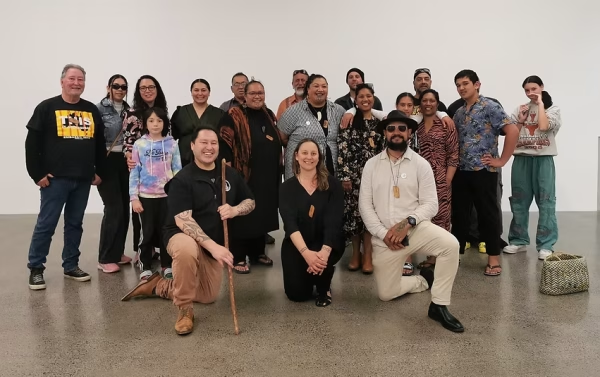
That goes back to an example I use of being values aligned. That’s really important when we start to bridge relationships, build relationships with iwi. I shared with some TTW colleagues some photos of our hui up north. Heaps of people turned up. Ours was part of it. It wasn’t the only thing, but ours was part of it.
It’s about being values aligned. Our team is an extension of Te Tira Whakamātaki. The kaupapa and the values that TTW has align with my own values. That’s what an enduring relationship looks like. Kaupapa and the projects that we engage in, that’s mahi.
But so long as we’re values aligned and, as a metaphor, TTW gifts me a home game and vice versa, then you’ve got me for life.