
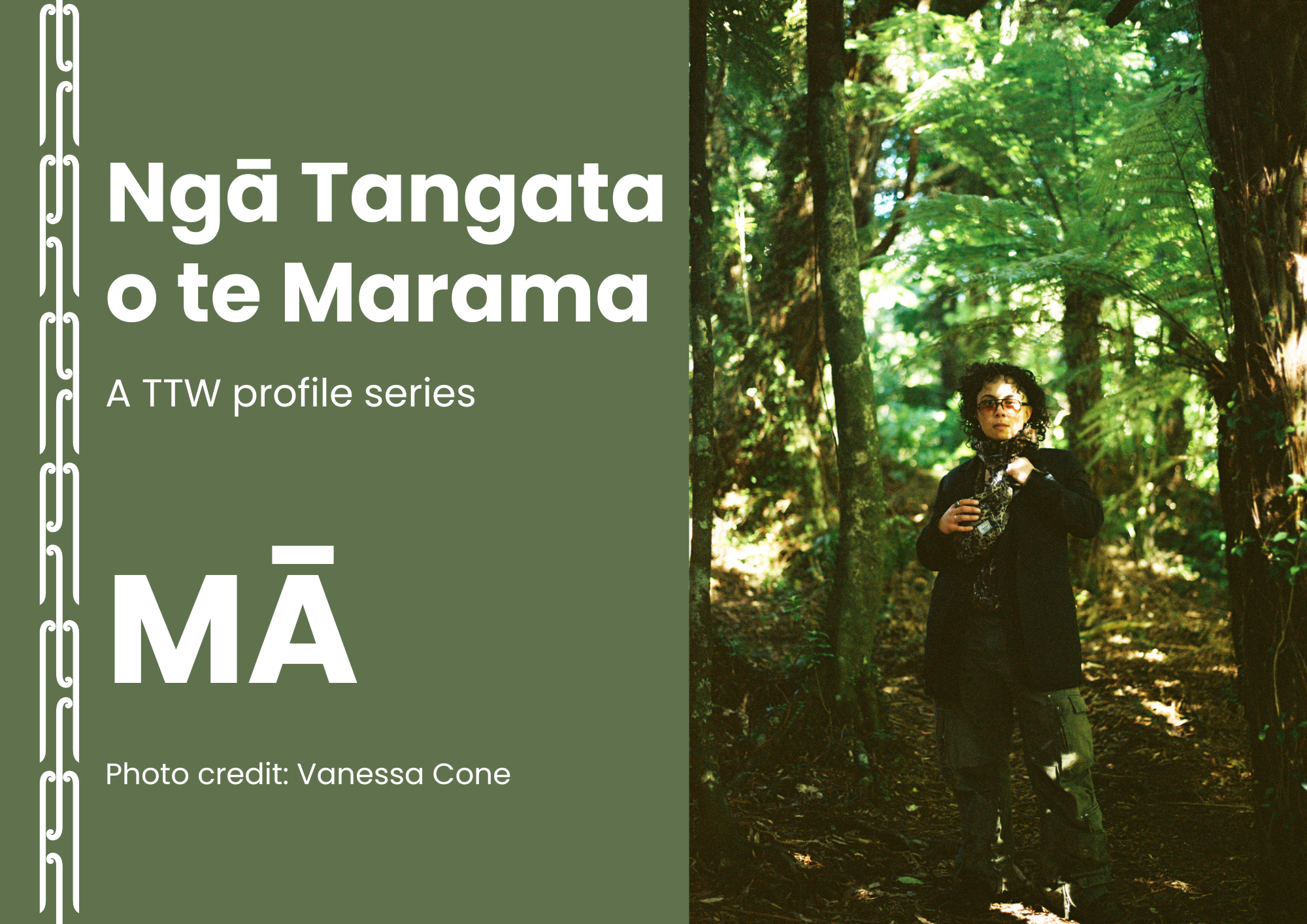
Ngā Tangata o te Marama | MĀ
In this third profile of Ngā Tangata o te Marama, we kōrero with MĀ, an artist, storyteller, and taiao worker whose mahi moves between the bush, the studio, the backyard, and her community.
In this kōrero, MĀ talks about her album Blame It on the Weather, writing Traps Jam, her writing process, disaster preparedness, kaitiakitanga, conservation as something that should be part of our makeup, and why Indigenous queer BIPOC artists are giving her hope right now.
Want to listen instead? The full audio kōrero is available to paid TTW members. Log in or explore membership options to listen.

Can you tell us a little bit about yourself? Who are you, where do you come from, and how would you describe yourself to someone you’ve never met?
I’m a descendant of Ngāti Porou, Ngāti Raukawa, Ngāti Kahungunu, and Tūhoe here in Aotearoa. I grew up in Wellington, born and bred. Neither of my parents are from here. Mum’s from Taupō, Dad’s from Christchurch. There are quite a few layers of urbanisation within my family.
I think people would assume I’m very quiet and timid. I choose the people that I want to talk to, which is true. Very observant first. Keep your cards close.
I’ve got some rapid fire questions for you, just to get to know you a little bit better. What is your favourite movie of all time?
Stand By Me. That’s the one film I watched all the time. I loved the way it showed friendship and going on adventures. They are right: you don’t have the same friends you had when you were 12. There’s truth in that.
What was the last book you’ve read?
Probably Tuesdays with Morrie. I would recommend it. It’s an easy read. It’s a really good book about humans trying to figure out how humans work.
What would be your least favourite chore?
I’d say washing the pots.
Sunrise or sunset?
Sunset. I love the end of the day.
Does that mean you’re also not a morning person or are you a morning person?
I am a morning person because of my mahi, but I think it’s just that your day is done. I’m clocked off.
Harry Potter or Lord of the Rings?
I’d say Harry Potter, if I had to choose, but kind of controversial with the author. Neither maybe?
What about Star Wars or Star Trek?
Neither, sorry.
What would be your go-to weapon in the zombie apocalypse?
An axe. I already know this answer. An axe and a rope. You’d need rope all the time, whether you’re trying to get into places or trying to pull things up. I know it’s going to be super handy. It’s in my grab bag.
Wait, have you answered that question before? You were very quick on that.
I kind of love the apocalypse. I kind of hope it happens.
What would be one song you never, ever skip when it comes up?
So many. I’d say True by TrinityRoots.
Beach, bush, or mountain?
Bush.
What about your biggest pet peeve in life?
I don’t know. You can tell kids who didn’t grow up having to do the dishes or who didn’t get hidings and they are my pet peeves because when they grow up to be adults, they’re really annoying.
What is your go-to karaoke song?
It would probably be Slow Dance, John Legend. It’s in my key. Very low kind of vibes.
What’s your best life hack that you’ve discovered recently?
Put seeds in your grab bag. Food seeds or tree seeds, because if it is all gone, then you’ve got to start again.
TTW’s been talking a lot about grab bags. What’s in yours out of curiosity?
I’ve got a little mallet, my rope, seeds. I’ve got a flint lighter kind of spark thing. I have a little bottle of rum and a pouch of cigarettes because I’m like, those first few days are going to be fucking crazy. I’m going to need my vices.
My thinking was you always need an easy way to make fire and an easy way to hold water. And I guess fluffy socks and a pair of thermals.
Is your love of the apocalypse driving these decisions or is this something you’ve always had?
A bit of both, for sure. My dad was real big on doing the early morning trainings. There’s a tsunami coming, so we’d just get up and get ready to go.
I also think people need to know to get their grab bag ready. It should be common knowledge. It wasn’t until I was talking about it with the album that everyone was like, ‘Oh shit, I don’t even have one.’ I’m like, ‘There’s been quite a few Natural disasters, you should be ready, bro’.

What place or places in this world shaped you most?
It would be my childhood home in Paekākāriki. My parents split up when I was two. My dad moved to the Kāpiti Coast. My mum stayed in the city. Both of those houses had a lot to do with it, but the Paekākāriki house was a tree house. It was just me and my dad. There were no walls. It was open plan, with curtains dividing the spaces, and he built a deck literally on trees. I was there until I was about 14.
My mum’s homes in the city also made me quite a tough cookie, because it was a lot of small cold homes that she always managed to create a really beautiful home for us. I guess it was two sides of survival that I learned quite quickly through the places I grew up in.
What do you mean by survival? Can you explain that a little bit?
Mum living in the city, she didn’t have a lot of money, so it was adapting to the environment that we were in. Whether that was a cold Newtown flat surrounded by buildings because the university bought it out and they were building student flats, it was learning to make a home wherever you go.
I guess that is the type of survival. Learning to make a home wherever you go.
Do you remember your very first memory from being outside? Can you tell us a little bit about it?
It would probably be my house on the Kāpiti Coast. It’s a small village, Paekākāriki. I was allowed to roam free pretty much as soon as we got there. There’s heaps of native bush around, the ocean right there, a train, and not a lot of people. That would be my first memory for sure.
I just took off a lot of the time and my old man had to come and find me. We were quite a sporty family, my dad’s side, so a lot of basketball, rugby, rugby league, and a lot of physical sports.
Who or what inspired you to pay attention to or care about the environment in the first place?
I’ve always been very aware of the good effects that being outside and being in the bush has for me.
My mum took me to Te Urewera for the first time and it’s where we were, where my family’s from. It was the first time my family reconnected to that land, my family is from Ruatahuna. We visited our marae for the first time.
Our marae is on a cliff edge, and as soon as you arrive, it’s like the marae with these two massive maunga in the backdrop, which are Kīha me Hiwi-ō-te-Wera. I think I would’ve been eight when I went there for the first time, and I was like, ‘Oh my God, it feels like this is my whole personality.’
It was really rugged, really full on terrain, real green. It was alive, so alive, and everything felt really fresh.
That is quite a big memory of mine. I’d say going back home.
What about today? What keeps that inspiration or motivation to do stuff in the bush alive today? What drives you?
Apart from the mahi that we’re set out to do, I think it was just that a lot of the people I know aren’t really aware of what’s going on. They go from home to their office job, maybe to the pub on the way home, then go home. That’s their normal. When you’re a city person, you don’t really think that the environment is part of your makeup, or that the bush is really part of your makeup, but there are trees growing everywhere.
I always tell people to go and visit a tree and watch it grow. You just need to find connection wherever you can. I definitely reckon it’s because there are more people not connected to the bush than there are connected.
What have you found works for getting people to pay attention to the tree around them, or bigger issues around biodiversity?
It sounds crack up, but I do reckon it was the album [Blame it on the Weather].
A lot of people are talking about the weather with me a lot.
They’re like, that whole small-talk thing that humans do, ‘that great weather that we’re having today,’ it actually feels like there’s a bit of weight to that conversation now.
I think it’s a lot more noticeable here in Wellington, especially with all the floods that are happening, and then realising that our whole infrastructure is shit and there’s a whole bunch of work that needs to be done.
People are starting to think, ‘Oh my God, so wait, if the pipes don’t work, then everything gets flooded. Then our cars are flooding and my home’s going to be flooded. Wait, is my home built on a wetland area?’ Everyone’s starting to think like that now, which is really sad, but good. Awareness is always good.
Can we talk about your latest album, Blame it on the Weather? What inspired it?
My sophomore album, Blame It on the Weather. I named it that because I feel like a lot of our world leaders will just blame it on the weather. The reason why there are tsunamis, mass floodings or landslips on people’s homes, or outrageous fires happening. It seems like our world leaders need something to blame, and it cannot be humans, of course.
It’s sarcasm for sure. I wanted the word weather to be there, as opposed to blame it on a flood, because I wanted it to be a general thing. It covers most of the bases. It’s something we can fully feel the effects of and be immersed in. We can touch it, smell it, hear it. That’s a thing humans can do, tap into our senses.
It also brings back that small-talk thing about talking about the weather, and being a bit more intentional with it. That was the hope.
It’s an album about the elements. I call it a bush album because I split each song into different categories. I have a song about flooding and Cyclone Gabrielle. I have a song about trapping. I have a song about pest plants. I have a song about being a product of urban drift and having to leave the beautiful rural area that our tūpuna are from to move into the city because we got told there were jobs, and then there are no jobs.
Now me and two generations of my family are stuck in the city, not knowing why we’re there.
I really wanted to write a story and get involved in a project that could hit all of the emotional strings as an artist, but also be very practical like my day job. It would be dumb if I didn’t incorporate the learnings I got as a ranger and share them with people, because not many people knew that being a ranger was a job until we got all that funding from Jobs for Nature.
I feel like any youngins should be working in the bush at a young age. If it’s your first job, it should be something like that, because you get practical work and your trades kind of things ticked off, but you’re also present a lot of the time. You have to watch and observe and monitor.
Those are really valuable learnings any human being should know, especially because it’s what we actually live in. What is bigger than the environment right now? What is more important than the environment right now?

How long have you been an artist, MĀ?
I think it’s five years.
I read that your parents were in the arts too. Is that sort of what gave you the confidence to jump right into that field?
Yeah, 100%. It was inevitable that I was going to be an artist. My parents are quite kooky artists, quite deep. Everything was about the art, storytelling, being a good storyteller, and being on the right side of history all the time.
It was inevitable that I was going to somehow jump in on that, but I wasn’t allowed their jobs. That was the goal.
Can you tell me a little bit about the process of writing? What’s your approach?
It’s very messy. There’s no kind of boundaries.
When I chose a song to write about, I thought about who the song was for. I’ll use my song Mahi as an example. I chose to write that song for the tradies. I wanted it to be a song my uncle could understand and relate to. I used real practical language in my writing. I named things that any tradie uses day-to-day, so they can connect to it immediately.
I am very big on ensuring that te reo Māori weaves through naturally. It doesn’t feel like I’m trying to do a reo verse here and then an English verse here. When I wrote it, I heard the word mahi more than work, so I’m going to put that down.
When I write words, I will always go pretty taumaha. I’ll go pretty deep, but then there needs to be some clarity at the end, or a bit of light, because it needs to wrap up. I don’t want to leave people in limbo. I don’t want to leave people in a hole. I always want them to be able to find their way out at the end.
That’s my process on writing. There were moments within the album that I wrote in the bush while I was at work or on my smoker. I would take little notes on my phone, or I had this little notebook at the time. Sometimes it was purely in the studio. Leo would be making the beat, and I’d be in the other room, but I could still hear it. I’d be writing all the words and it would look messy.
There’s a brainstorm over here, some words here that I liked, some angles that I liked. If I wanted to create a character like I did for Traps Jam, I’ll create two characters and make them talk to each other. To generalize, very messy, no rules, has to end on a positive note.
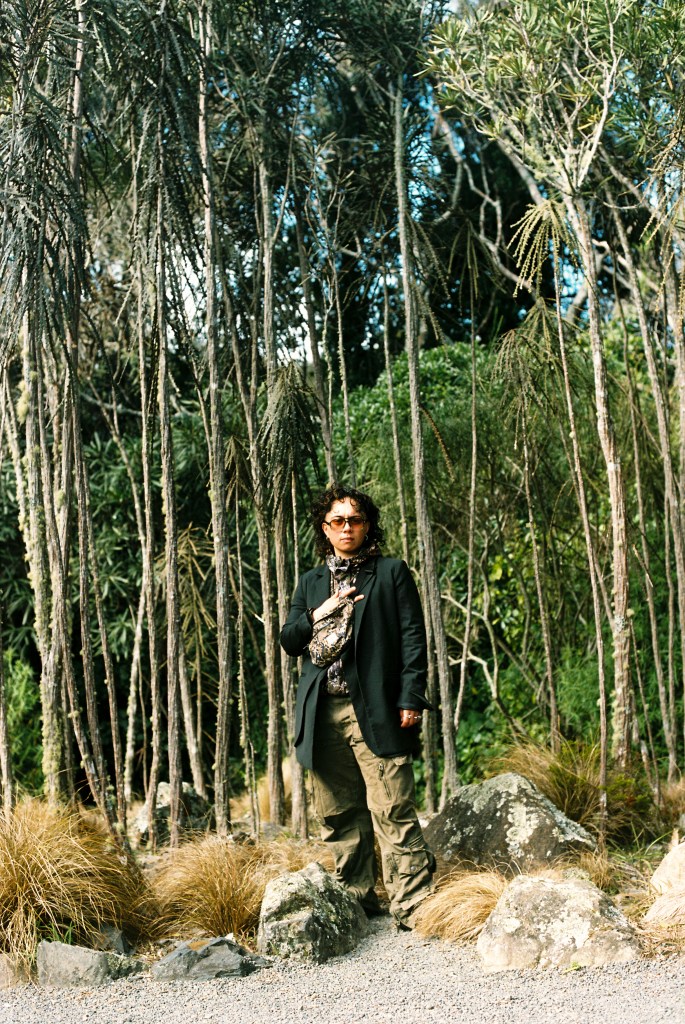
Can you tell me about Traps Jam? How did you create it, and what does it mean to you?
I was always going to write a song about trapping. It was part of our work programme, but it was quite hard for both of us, myself and the producer, because he was like, ‘What’s a song about traps sound like?’
He was like, ‘What are trappers usually? What kind of people are they?’ I was like, ‘They’re pretty rough, to be honest.’ You’d have to be a loose unit to be a trapper, but it’s always those rough men who are actual little sweeties inside once you get to know them. They have to do the gruesome work, but they have to do it with a good state of mind and good intentions, otherwise you’re crazy.
It was a rock song first. But it didn’t feel right. We scrapped that quite quickly. I think we went there because we were thinking about the sound of a trap. I brought a trap into the studio, set it off and tried to capture the sound, but it just didn’t feel like it was capturing what a trap looked like to me.
Then Leo, who was on the production, got on a piano and started riffing. I stood by him and started riffing with him, and it ended up turning into this beautiful melodic, choir-y sound. I was like, ‘Ooh, I can feel something with this. This actually feels really nice.’
But we couldn’t stay there because it wasn’t reality. It’s not what trapping is actually like. It sounded more like when the possums go to heaven kind of soundtrack.
We parked it for ages, but I had already written the words when we did that choir-y sound. I was going to do it from the perspective of a possum, and then from the perspective of a bird or a kererū.
We parked it for six months and had only recorded what we had written that day on my phone as a voice memo. I was so connected to that song that I told the guy who mixed our album that I wanted him to mix the voice memo.
He cracked up and was like, ‘You can’t really mix a voice memo.’ I was like, ‘I don’t care, this needs to be on the album.’ So we put it on the album. It was a little bit confusing for some listeners because they were like, ‘What is this?’ But it was a holding point: ‘Just wait, we’ve got to wait for this baby to cook. She’s coming.’
Then we played it live. We had to figure out how to play it live because I really wanted to sing this song. We played it live for about eight gigs within our tour and loved it. Then, with some of the money we made from the tour, I asked, ‘Can we go into the studio now?’ Me and Leo went to the studio and recorded the whole thing. I brought in some singers and we recorded Traps Jam to her final form.
I’m proud of this song. It was actually buzzy that it ended up being a bit of a country bumpkin song as well, but I think that’s just what happens. That’s what was meant to happen. I think she was a bit of a transformer, kind of Mystique character, that has no face. That’s Traps Jam to me.
Did TTW’s Restorying the Possum wānanga in Wellington, shape it at all?
Oh yeah. That’s another thing. I was thinking more about the music and the words. When we were in the studio writing the first version, that’s how my words came into play. I was talking to Leo about this wānanga that we went to, and just hearing perspectives is a crazy thing.
When you can actually hear, it actually rocked my world being like, ‘Oh my God, it’s not their fault they’re [possums] here.’
The fact that there aren’t many over in so-called Australia now for them to continue their practices is crazy. It was a different way of looking at colonisation for me, and seeing a whole other layer of the effects of it and how it’s adapted within the culture that it lives in. Seeing a possum on the road is a childhood thing, that you try and run it over, and it’s embedded in our brains.
Once I went to this wānanga, I was like, ‘Oh my God, these are actual taonga species. What the hell?’ They’re species we are thrashing all the time without thought. I know so many kids in Tuhoe that just go possum hunting all the time.
I feel like everyone should be involved in that wānanga because it made me think a lot about the way humans move with other species and how we move with other species and how we move with each other. I think Māori and our Aboriginal whanaunga felt a little bit more connected after that wānanga, being like, we can really back each other here with this kaupapa. It was an honour to be at that wānanga, but it was also an honour to be there as a human being. That was pretty crazy.
How often to you go to a wānanga and there’s an outcome? A way of making this better? Because usually wānanga is just thinking, feeling, back to thinking. But it was like, ‘no this is an option. This is how we can actually do this.’ It was cool man.
When you hear the word conservation, what comes to mind?
The word conservation feels like government language, for sure. It’s probably just what it’s associated with here for me. But the mahi is obviously a lot different.
It feels like something we all need to get on with, for sure, but it’s definitely a Western way of looking at something we’re responsible for.
What do you mean by that?
I’m a little bit stuck on the word, but conservation feels more like a job. Whereas if it was something that was part of our makeup, if everybody in every house was a conservationist, I guess that would be humans living with the land the way it should be. It should be part of our makeup and part of the things we take care of.
Because it’s a word to describe something, it feels like something I have to go and do, as opposed to something I just do. That’s the way I see it.
What role do storytelling and your role as an artist have in getting people to think differently about what conservation is?
With my methods of storytelling, it’s a bit of calling out, to be honest. I use a lot of my storytelling to either talk shit about something that’s not working, feel a lot of emotions about something that is hurting, or try and articulate something I learned that could work and put that in my storytelling.
As an artist you are responsible for the listener. I feel like storytelling needs to wake people up, for sure, but in a way that works. My language should be understood by someone who studies English. It should be able to make sense in every human. And I think the only way you can do that, really, is by calling them out.
With art, there are not really any boundaries. It’s not like I’m a politician and I have to watch what I say.
As an artist, I am allowed to say what I’m going to say, and that should be something that gets taken on because there is no filter here. There’s nothing blocking between me and the listener. It’s just me going, ‘You’re being a shit cunt. Wake the fuck up’. And that’s my job, today.
Then there might be an artist who is a little bit more caring, a little bit more like, ‘Wake up dear. It’s flooding.’ Every artist has the responsibility to bring a language that makes sense to everyone. That’s the way I see it.
What does kaitiakitanga look like to you? As an artist, as a person, what does it look like day-to-day and in the bigger picture?
If I start at home, my home has a backyard, so I’m going to look after that backyard. Looking after it means getting rid of all the weeds, making sure it’s clean, making sure there’s no rubbish. Then my backyard has space for a garden.
I’m going to plant a garden, and because my backyard is shared with two other people, I’m going to give some kai to my neighbours and offer for them to jump in and help out. Then we end up with too much food, so we start giving food to our other neighbours. Then the neighbours actually meet each other, start talking to each other, and start sharing things together.
That’s one way that I definitely do my day-to-day.
If in any way my involvement with te taiao allows me to see people better, then I think it’s a good day.
If I’m able to share food with my neighbours, then I’m actually looking them in the eyes and offering them something. They have to accept it or not, but they also have the option to look in my eyes and see me.
Humans are so good at passing each other by these days and just getting to where we need to be. But if you ever get a chance to actually look at a person properly, especially someone you live next to, for some reason it feels like a really big thing. It should just be one way that we all look at ourselves as kaitiaki. We take care of each other by feeding each other.
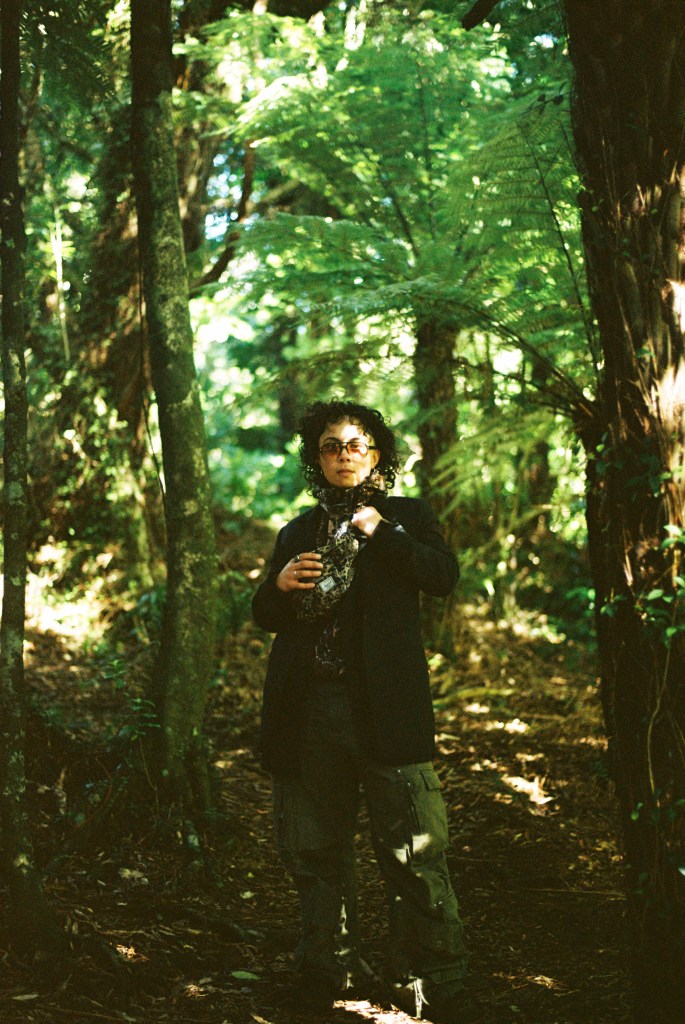
What keeps you going when things feel hard or slow?
I guess it’s the fact that I chose to continue living, so I am going to do that. I’ve learned a lot, probably from my first album, about how to be in the dark quite well, and how to be in really low spaces quite well. I’ve learned to embrace them a lot better.
Because I made a decision to continue to wake up and do my day, even if it’s a dark day and a hard day, I’d say that it’s a bit of a privilege. For me, that means I’m feeling something. That means I’m alive, and I’m going to lap it up and be dark and be sad, and not take that stuff for granted, because I don’t think you’re supposed to be super happy and go-get-it all the time.
It’s part of our makeup. A big thing for me, especially working in the taiao spaces, because there are a lot of losses and a lot of hard things to confront, is first and foremost always checking that the pulse is going and it’s moving.
Usually if you’re sad, your heart rate is at a different pace. I’ll follow the heart rhythm that is set for me during the day and take it on fully. I’m like that with my friends who have hard days. I’m just like, ‘Wow, it’s such a privilege to be able to be sad right now.’ So be sad, don’t waste it. Don’t waste it.
Lean into it for sure. Don’t avoid it. Just grab it.
What advice do you have for a young person thinking they want to follow in your footsteps?
I’d say observe, monitor, and then make your own outcome.
You can observe and you can analyse things as much as you want, but you’re the one who’s got to write down what the outcome is for you. So kia kaha.
What’s giving you hope right now? What in your life, work, or art is giving you hope?
I’d have to say the art community at the moment is giving me so much hope. The art community within Aotearoa, and by art community I’m specifically thinking about the Indigenous queer BIPOC art community.
It’s a space that’s always going to be underground, but I don’t know if it’s getting louder. I can hear it from the top as well. There are so many more Indigenous artists coming through and telling their own stories and perspectives, and now that’s just part of records now. It’s good for our babies to be able to see that representation of themselves.
Another beautiful thing about it is that most Indigenous queer artists are usually pretty hearty and really solid. In my mind, they are frontliners in regard to all of us moving forward, all of us humans moving forward, because we are in charge of reminding humans that they’re human, and reminding people that they have feelings they probably need to address or can look into.
The collectivism that is happening right now is super inspiring, and I’m super honoured to be a part of it right now.