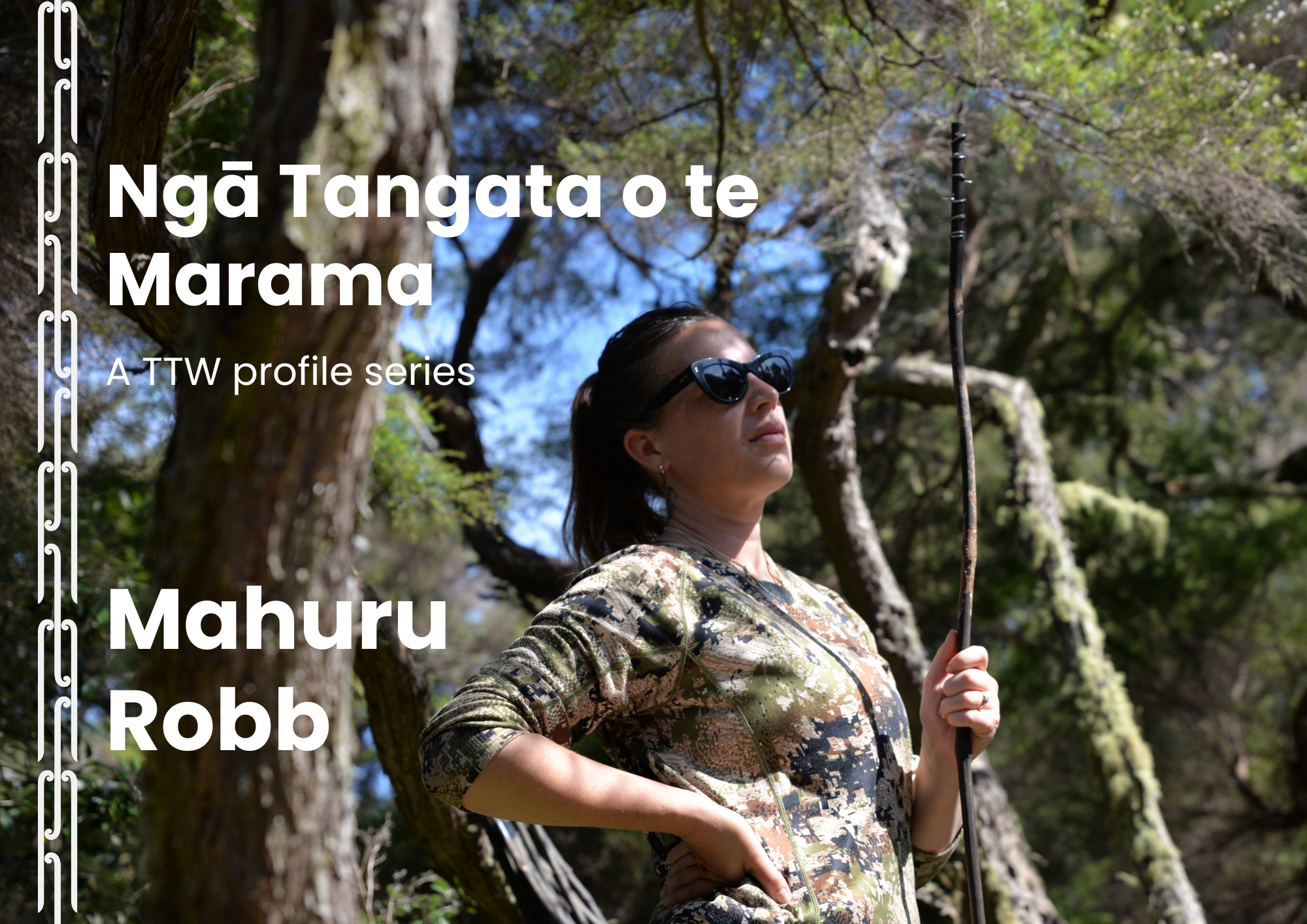
Ngā Tangata o te Marama | Mahuru Robb
Some people arrive at environmental work through a straight path. Mahuru Robb did not.
Her story moves through art, ecology, field work, freshwater fish, wetlands, mātauranga Māori, science, community relationships, and the slow, long-haul work of restoring places with the people who know them best.
In this profile, Mahuru talks about following curiosity, learning from the wetlands, working at a pace that does not burn people out, and why Māori-led environmental work needs to be more than something people consult after the decisions have already been made.
It is a kōrero about patience, role, responsibility, and the kind of hope that starts small enough to hold in your hands.
Want to listen instead? The full audio is available to paid TTW members. Log in or explore membership options to listen.

Tell us a little bit about yourself. Who are you, where are you from, and how would you introduce yourself to someone you have never met?
I’m Mahuru Robb, and my whānau is from Ngāti Awa and Ngāti Ranginui , around Bay of Plenty, East Coast way. I currently live out near Whāingaroa, Raglan on the West Coast, on our whānau farm.
I’m really lucky to live in an environment that supports and fosters my passion for our taiao. I’ve always been a bit of a nature nerd, and I thank my grandma, who was a botanist, and my dad, who was a fisherman and outdoorsy type guy, for that.
We were always out camping and in nature whenever possible. Diving. Even though we lived in the city, we had a real passion for the outdoors. That’s always been a theme.
When I went to university, I decided to do biology and ecology, and a whole new world opened up to me. The world of science, which I didn’t love at school. I liked painting and art and that kind of thing. I have lots of facets to me, but essentially connecting to the environment and understanding the world around us is really my passion and driver for my hobbies, what I do, and who I am.
As I did work in that taiao space, mostly in the science field, there was something really missing for me. That was understanding who I was, being wahine Māori in the environment and in our wider ecology. I did a master’s looking at how mātauranga Māori and science worked together to understand the health of wetlands.
That took me on the trajectory I’m on now. It’s fascinating. I’m always learning new things, and understanding te taiao from a Māori perspective is a really grounding experience. It makes me feel like I’m contributing to something much wider than myself, and that really keeps my passion going.

Let’s go back to your interest in art, but your choice to go into biology. What drove that decision?
I’ve never really had a specific plan for my life. Some people, from quite a young age, have a vision of where they want to go. I’m the type of person who says yes to different experiences.
When I finished school, I really enjoyed languages. I did fashion and sewing at school. I did painting. That’s what I really loved. Maybe that was because of how science, maths, and those types of subjects were taught. It didn’t resonate with me at all.
When my friends and I were talking about going to university, I knew I wanted to do that. Education was a real priority in my family. I went through the University of Otago prospectus, highlighted all the things that looked interesting to me, and ended up going, wow, it looks like I’m doing a Bachelor of Science in zoology and ecology.
I didn’t really know what that was. I had no idea what jobs I would get out of it. I also did te reo Māori papers and some anthropology as side things, but really focused on that science aspect.
Science and statistics, which I did not love at school, were taught in a context I cared about. Statistics was more about understanding population dynamics, breeding, and carrying capacity. It suddenly all made sense to me. That opened up my mind to actually enjoying these subjects.
Science wasn’t just chemistry and Bunsen burners. It was observation of the world around us. I have naturally had those traits, being observant of the environment around me and having a keen interest in plants and animals in particular.
That’s a cool way to approach university. I think a lot of people go in saying, ‘This is the career I want at the end,’ rather than picking courses that interest them. That is a really interesting way to do it.
Without knowing it, passion is what drives me. It keeps me interested. It keeps me driven. It keeps me open. It keeps me eager to know more.
As a teenager, knowing what I know now, I really had no clue what careers were out there. It wasn’t until I was getting to the end of university and people were saying, ‘What are you going to do for a job?’ that I thought, maybe I’d work for DOC or something like that.
I ended up doing marine mammal and seabird observations as an observer on trawling boats, working on fishing boats. The opportunity came up, and I just went for it.
After that, I got a job as a consultant. That’s when I could move to Raglan full-time, because they were based in Hamilton. I ended up tracking migratory shorebirds over proposed wind farm sites, doing lots of outdoor work and lots of teamwork.
I really enjoyed being part of a team, understanding field leadership, working with lots of different personalities, and working with scientific method. How you develop surveys across huge landscapes over long periods of time, and what you’re looking for.
Through that role as a junior consultant in a small firm, I got to experience lots of different things. That’s when I first learned about freshwater surveys and freshwater ecology. There were these pivot points within my career that shifted me in different directions. For me, one of those was learning about eels.
I had no idea that eels were so fascinating. That’s what got me really interested in freshwater fish and then, essentially, in wetlands. The wetland just down from our whānau farm was the perfect field site for my master’s research.
Through that consultant role, I could see so many opportunities. I’d cross paths with iwi and hapū members as part of resource consent conditions. Some conditions were to work with Māori, iwi and hapū, so I’d have people coming along with me to help with surveys.
Through that, I realized I really don’t know anything about these environments. The people who do are the iwi and hapū members who have lived here for generations, who know so much amazing information that would never be captured in the science monitoring I was doing.
That kept burning in the back of my brain. Why is this not done more? Why are we not understanding more from an iwi and hapū perspective? There are some serious gaps here.
That’s when I came across the work around cultural health indicators with Gail Tipa, and then Garth Harmsworth with the wetland work. That’s when I started to really think about a master’s and what I could do.
Even that process was challenging. It was 12, 13, maybe 14 years ago when I started my master’s, and nobody in science really thought about mātauranga Māori at all. I had a lot of trouble getting a supervisor at the University of Waikato, which at the time had an amazing Māori and Indigenous knowledge department, staff, connections with Waikato-Tainui, the river settlement, all these things.
I could not find a supervisor. I got dummy passed to one of the only Māori freshwater scientists at Waikato, Ian Duggan. He said, ‘I don’t really understand what you’re doing, but I can help you with your analysis, your statistics, your thesis structure, but you need to get some strong external supervision.’ So I approached Garth and eventually got on to Shaun at Manaaki Whenua.
These pivot points have led me down a windy path. Through all of that, another key aspect when you are looking at restoring environmental health is pest control. That was a recurring theme, and it has become a stronger theme in the work I do now. I see a real opportunity there to support iwi and hapū.

What a fascinating journey. What is your whānau farm like and how did you end up there?
We are so, so lucky to have this place. It’s really through our close whānau relationships with, Taruke and the Thomson whānau at Mōtakotako marae. They are from Ngāti Whakamarurangi. We have been coming out here to this farm and the Thomson farm since I was 11 years old. Taruke grew up around here and has been really supportive, leading the work at the wetland down at Toreparu from the hapū perspective.
We work very closely together in an ongoing sense. The master’s was my first step into that wetland world, but I have continued it. It’s still ongoing now.
I coordinate workshops with the local community and marae, and a lot of that is voluntary. I try to get projects through work to align with that, but that doesn’t always happen.
I have the privilege to live on this whenua. One of my contributions to the community, the marae, and the hapū is to continue this wetland work long-term. It’s a long-term, large area with a lot of issues, but also a really motivated community and marae that are determined to lead this work into the future for the betterment of their taiao, and their people, their whānau.
That type of work with a motivated group, on land that you live on, seems really satisfying. Is it?
Definitely. That’s why I only work four days a week, so I have time to do these other things. Everyone is doing what they can. They either run farms around the edge of the wetland itself, everyone has jobs, they’re busy, and there is a lot going on in people’s lives.
Taking steps at a manageable pace is what I’ve learned. You can’t try to do everything at once. It’s easier to bring people along on the journey when you’re not rushing to restore the wetland in five years. That’s not going to happen.
It is a long-term, potentially forever project. Being able to work with the community, the marae, and Ngāti Whakamarurangi at a sustainable pace is really important for longevity, and for not burning everyone out in the process.

Before we get deeper into your work, I have some rapid-fire questions to get people to know you better. Let’s start with beach, bush, or mountain?
Bush.
Favourite movie of all time?
I’m not a real movie watcher. Maybe more a doco kind of girl. As kids we used to watch Priscilla Queen of the Desert a lot, its so funny
What was the last book you read?
A Court of Thorns and Roses. It’s my first foray into fantasy.
The other one is The Women by Kristin Hannah. Actually, no, that was the last one I read. There are two Kristin Hannah books, so I think it’s called The Great Divide or The Women. I can’t remember which was the most recent, but I enjoyed those.
Sunrise or sunset?
Sunset.
How about your least favourite chore?
Cleaning the bathroom. Cleaning the bath and showers is my hated one, probably because you’ve got to pull hair out of the plug hole. That’s a major ick. Whereas I love vacuuming. That’s fine.
Harry Potter or Lord of the Rings?
Lord of the Rings.
Star Wars or Star Trek?
Star Trek. I’m not a Star Wars person.
What would be your go-to weapon in the zombie apocalypse?
Probably my rifle.
What about when you run out of ammunition?
Bow and arrow.
Are you quite skilled with the bow and arrow, or do you have a crossbow?
No, I don’t. But when I went to Norway, I went to this Viking museum and they had all these Viking games. I had never picked up a bow and arrow before. It was one of those old-school ones, not a crossbow or a compound bow, just one of those traditional old ones. I got three bullseyes in a row. Then I was like, ‘Maybe I need to take up archery. This is fun.’ When I still had my horse, I was like, ‘Maybe I could do archery from my horse.’
What is one song you’ll never skip?
SpottieOttieDopaliscious by OutKast
What would be your go-to karaoke song?
Maybe something by Lauryn Hill.
Is there somewhere in this world that shaped who you are most as a person today?
I’m going to say where I live now, for sure. We are close to the beach. There’s an amazing wetland. I spent a lot of my childhood here. Every school holidays, we’d come up and stay with my mum.
We spent a lot of time on quad bikes in the bush, making forts, missioning around the farm and down at the beach and around the stream and wetland. It’s where I live now, which is why I feel so lucky to be back here.
I grew up in the city, in Wellington. As a city kid, being able to experience the natural world and actual freedom was huge. We used to disappear in the morning and be home at dark. We could take the quad bikes out and mission around with machetes and hatchets and things.
There was very little adult supervision, but we had freedom to learn, observe, and see seasonal changes. We’d do fishing, whitebaiting, hunting, all sorts of stuff.

Does the curiosity you described earlier have anything to do with those childhood experiences?
For sure. I think I’m realising now, in later life, that I tend to be more of a yes person. I say yes to opportunities, to doing something different, even if it makes me a little nervous or scared.
That openness to trying new things has really set me up for life and shaped who I am.
Do you remember your first memory from being outside?
The one that sticks out most is going camping with my dad and my siblings. We camped and then did a tramp to a hut overnight. I think it was just out of Wellington. I can’t remember the exact location, but that really shaped how I interacted with the environment.
Dad was a bit of a bird nerd. He pointed out different bird calls, what they were, the different birds, the way they flew, all that kind of stuff. My nickname at high school was Bird Nerd, because I would share these random nature facts with my friends that I’d learned as a kid. To them it was just totally weird.
That experience of being out in nature, tramping, crossing rivers, all that kind of stuff, has really stuck in my mind.
The other one is that my dad is such a mad keen fisherman, and we used to go to the Marlborough Sounds for some of our holidays. I remember catching this huge blue cod, and I was so gutted that it was going to die and we were going to eat it.
I remember leaning over the side of the dinghy on our way back to the bach, holding the fish over the side, trying to keep it alive. As soon as we got to the wharf, I jumped out with this fish, ran the bath, put a bunch of salt in it, tried to keep the fish alive in the bath, and then it died.
I remember my dad knocking on the bathroom door: ‘Mahuru, is it okay if we take the fish and have it for dinner?’ I was so gutted. I was crying. I said, ‘Okay, but nobody say that it’s delicious.’ It had to be disgusting. No one was allowed to say that the fish I got was good, because I was so sad that it died.

You mentioned your grandma and your dad specifically, but who or what inspired you to pay attention to the things around you?
I think a lot of that observant nature I was born with, in lots of ways. It was always noted in my school reports. ‘Very observant’, that kind of thing.
I tend to sit back and watch more than get involved. That’s still how I am today. In meetings, I sit back, observe what is going on, listen to what people say, and tend to go away and think things over before having an opinion, especially if it’s something I’m not super confident in.
I think a lot of it I was born with, just being observant. I’m not sure exactly where that came from, but I’m going to go with that.
What are you doing now for work?
At the moment, I’m working as a kairangahau, Māori researcher, for the Bioeconomy Science Institute, BSI, formerly Manaaki Whenua Landcare Research.
I’ve got lots of different projects on the go, but I’m really interested in doing some work around kiore and how we navigate supporting kiore for iwi and hapū who see them as taonga within the context of Predator Free, where there’s a more blanket eradication approach for rodents.
How do we navigate that tension between supporting iwi and hapū who want to potentially maintain kiore populations within their rohe, while also getting rid of the other rodents that maybe iwi and hapū don’t want? That’s something I’d like to get more into.
That sounds like quite a balancing act. How do you navigate that? What have you found so far?
Because we live in a colonised country, there are constant tensions when it comes to understanding and honouring our values as Māori, or iwi and hapū. Obviously, we are not homogenous.
Then there are the structures and systems that we operate in as New Zealand, and the colonial mentalities and ways of operating. There is constant tension. How do we navigate that? I’m still figuring it out, I think.
Most importantly, it’s continuing to validate the ways of knowing, the ways of doing, the ways of being that we have as Māori, within a context that doesn’t necessarily support that.
I think we navigate it by continuing to uplift, understand, and support whānau, hapū and iwi. As that momentum grows and our ways of being are strengthened, and it’s already happening, we have a really strong footing to move forward into a future that is led by our whānau, hapū and iwi.
That’s where I see that tension. Don’t expend all your energy on what you can’t necessarily change. Focus on uplifting and supporting what we are passionate about as Māori, and what we can change within our own communities.
Where do you see yourself fitting into that larger navigation?
I feel like I sit in an in-between space. That is a really useful skill to have. With my science background, I can bring in tools that may support whānau, iwi and hapū.
Navigating that interface is a useful skill. Being able to move across worlds, understand the aspirations and values of our whānau on the ground, and go, there are actually some tools that may support that.
The way I frame things in my mind is that science just provides tools. They might be useful, but they also might not be. Are they useful in supporting our ways of knowing, our mātauranga, our values, the way that we see the world? It might be yes, and it might be no.
Could we adapt things? I like to see the solutions, how we propel ourselves forward as Māori in the world. I try to find: how could we do this? What have we got available to us? How can we move towards our aspirations and goals as Māori? That’s my kind of space.
What advice would you have for young Māori researchers or students who hear your path and think, ‘I want to do what she does’?
Just follow your passion. That is probably the key message. If you follow your passion, you’re never going to be on the wrong path. Whatever windy direction you go in, sometimes it feels like maybe you’re on the wrong path, but it always comes together in the end.
It is that passion. It is knowing yourself, particularly for us as wahine Māori in science and in this taiao space. Be really confident in knowing who you are, trusting your intuition, having your passion, and letting that propel you forward.
There will be lots of distractions, lots of people telling you what you should and shouldn’t be doing. Trust that you’re on your path. It might not be the same as others. It might not be the same as mine, and that’s fine.
At TTW, we have been exploring what kaitiakitanga means. What does that word or concept mean to you on a day-to-day basis and in the big picture?
Maybe this is my hot take. Particularly in the taiao space, not everyone is kaitiaki. I hear non-Māori co-opting this word, and it is a real bugbear of mine that our concepts and reo are getting redefined, particularly by non-Māori in this taiao space.
With schools, with Pākehā restoration organisations, just stick with guardianship. Stick with stewardship. Don’t co-opt kaitiakitanga.
I see kaitiaki as a role, as quite a specific position within, say, a marae or hapū. It’s not self-proclaimed. It is a specific role given to people with real knowledge, passion, and interest in our taiao. Everyone has their role. Not everyone has to be kaitiaki.
I’m learning that about myself too, that I don’t have to do everything. I can focus on the things I’m good at, that I feel most passionate about. I think that applies here as well.
Kaitiakitanga in a wider sense, absolutely, as Māori we can all embody that. But when it comes to practical action and embodying that on the ground, we don’t all have to be that. We each have our roles that contribute to the bigger picture.

What is the danger in people co-opting terms like kaitiaki and kaitiakitanga?
It really diminishes the role of Māori over their own rohe, and it diminishes that specific, important type of connection Māori have with whenua, which is through whakapapa.
That is what I understand as the defining term. If you have whakapapa, then you have a different connection to te taiao, to your whānau, to people around you, to atua, to all sorts of things, than tauiwi do. And that is okay.
It’s okay for tauiwi or Pākehā to have a different type of connection. People don’t need to co-opt, colonise, and redefine these terms. Just use your own type of connection.
I think it’s a colonial mindset to uplift, redefine, and co-opt Māori terms when you’re not Māori. It’s okay to have your own terms, your English words, your understandings.
It doesn’t mean you can’t contribute to the same vision. You just do it in a different way. You don’t need to diminish that special and unique whakapapa connection that Māori have with our world as Māori.
What would you say is the biggest opportunity for Māori-led environmental work right now? Why should it take centre stage?
It goes back to who knows the most about the environment we live in. It is the people who have been here, who whakapapa, who understand so many different layers that can’t be captured in a 10-year study or a five-year study of a species or environment.
There are generations of observations. Just because it maybe hasn’t been captured in numerical form or graphed in a particular way, it doesn’t mean that it isn’t valuable.
The opportunity is to have more of our young people, our rangatahi, out there doing this work, continuing this legacy from their tūpuna.
I think our understandings of te taiao provide a framing that science or other methods just cannot capture. You lose so much knowledge when you are not including Indigenous knowledge. There is so much that you miss.
The real opportunity is for our people to be leading this work. It doesn’t mean we can’t bring in tools from other disciplines to help us on that journey, but it really needs to be led by Māori.
What is giving you hope right now, Mahuru?
I’m a really hopeful person, maybe to the point where sometimes I’m a little delusional. What gives me hope is working alongside other passionate people, and seeing what our whānau, iwi and hapū are doing on the ground, whether it’s small stuff within their local wetland, pest control, or understanding more about their taiao.
Seeing the passion in others gives me hope. That’s the momentum we need to change things on a bigger scale, and it starts small. When you are working in those smaller scales, that hope, excitement, drive, and passion are front and centre. They are not drowned out by trying to go too wide, looking at the global issues and going, oh my God, this is too much. That sucks the hope out of you.
Starting small within our communities is what gives me hope. We are making step changes in the world that we can have influence over and not getting too overwhelmed by the bigger picture stuff.